


How does an evaporative cooler work?
Evaporative coolers, also known as air coolers, operate on the principle of water evaporation. Hot air is drawn in through a water-soaked cooling pad, then blown out by a fan at a temperature 4–10°C lower, depending on ambient conditions. Unlike air conditioners, evaporative coolers do not use refrigerant gas or compressors for cooling, resulting in significantly lower energy consumption.
In addition to cooling with water vapor, evaporative air coolers also filter dust, balance humidity, and circulate air, making the room more comfortable during hot weather.
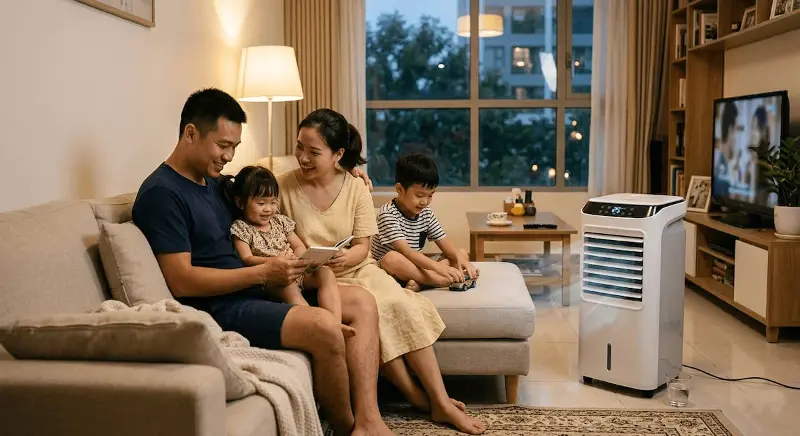
Factors affecting electricity consumption
The power consumption of an evaporative cooler depends on several factors: wattage, operating time, airflow mode, and the size of the room. Coolers with a wattage above 150W, used in large rooms, will consume more electricity than mini models of 60–80W. Additionally, ambient temperature, humidity, and the room's layout also directly affect cooling efficiency.
Instructions for using an evaporative cooler to save electricity.
The fan should be placed in a well-ventilated area, near a window or door, to allow for natural air circulation. Do not place the fan against a wall, an obstruction, or in direct sunlight, as this will reduce evaporation efficiency and increase the temperature of the water tank.
When first turning on the machine, select high speed for rapid cooling. After 10–15 minutes, you can gradually reduce the speed to save electricity and maintain stable humidity. In highly humid environments, it is recommended to use the regular fan mode instead of the water-cooling mode to avoid mold growth.
Combining an evaporative cooler with a ceiling fan helps distribute the cool air more evenly, reducing the continuous running time of the unit. This is a simple trick to save electricity while still maintaining a comfortable feeling in the room.
Some people add ice or cold water to the reservoir to increase cooling efficiency. However, this should only be done when the temperature is too high and not frequently to avoid damaging the water pump or causing condensation on the machine's surface.
Common mistakes when using evaporative coolers.
Failure to clean the cooling pads and water tank regularly will lead to the accumulation of dirt and algae over time, reducing efficiency and causing unpleasant odors.
Using an evaporative cooler in a completely enclosed room increases humidity, makes the air heavy, and reduces the machine's efficiency.
Avoid leaving the air conditioner running all night if the room is small or has high humidity. Instead, set a timer or use it on a low fan speed while you sleep.
Proper maintenance helps the equipment last longer and operate reliably.
To ensure the fan operates reliably, the filter, water tray, and fan blades should be cleaned regularly, at least once a month. Check the water level frequently to prevent it from running dry and damaging the pump. When storing the fan in cold weather, ensure it is completely dry and wrapped tightly to protect it from dust and insects.
If you notice the fan making loud noises, producing weak airflow, or emitting unusual odors, you should stop using it and check the pump and motor system. Early maintenance helps prevent serious damage and saves on repair costs later.
Suggestions for choosing an evaporative cooler that suits your needs.
For small rooms (under 20m²), a fan with a power of 80–120W is sufficient, while for larger spaces, choose a fan with a power of 150W or more.
Additionally, prioritize models with features such as automatic pump shut-off when the water level is low, remote control, and wheels for ease of use.
When used correctly, evaporative coolers not only provide instant cooling but also save energy compared to many other types of cooling devices. This is an ideal solution for those who want to balance cost, efficiency, and comfort during the sweltering summer months .