


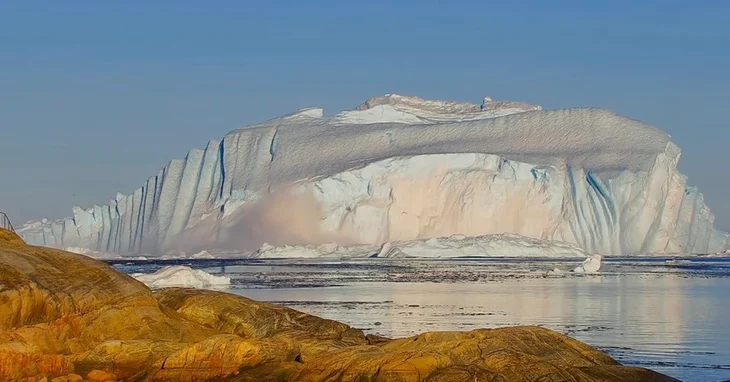
An iceberg unexpectedly capsized near the coast of Greenland - Photo: AFARTV
According to IFLScience on August 4th, a video recorded on July 25th in the town of Ilulissat, western Greenland, shows a giant iceberg slowly approaching the coast before suddenly flipping over.
In just a few minutes, the massive iceberg tilted sharply to one side, causing large chunks of ice to break off and create waves that spread towards the shore.
The entire process took about 55 minutes, which was then shortened by afarTV into a 10-minute video.
What's most striking is when the iceberg flips over, revealing the part that was previously submerged in the water with its distinctive deep blue color, a stark contrast to the snow-white ice layer above.
According to the US National Aeronautics and Space Administration (NASA), only about 11% of an iceberg's volume floats on the surface of the water, while nearly 90% remains submerged. Therefore, humans rarely observe this "belly of ice."
A short clip shows the scene of an iceberg unexpectedly flipping over near the coast of Greenland on July 25th - Source: YOUTUBE
NASA scientist Dan Berisford explains that icebergs often have a white surface because they are covered in snow while still attached to glaciers or ice shelves.
After breaking apart, many icebergs will flip to a new equilibrium position, revealing the previously submerged, deep blue ice.
In the video, the iceberg stops after approaching the shore, then gradually becomes unstable as it melts and chunks of ice continuously break off, shifting its center of gravity.
When the center of mass shifts beyond the equilibrium threshold, the entire iceberg suddenly flips over to achieve a more stable buoyancy.
Scientists say that iceberg flipping is a natural phenomenon and usually occurs after they break away from the ice shelf or when they melt unevenly.
During their drift, icebergs can also rotate multiple times, leaving behind streaks of water and traces of melting, which help researchers trace their formation history and journey.
Although the incident at Ilulissat caused no damage, experts warn that this phenomenon could create large waves and pose a danger to ships operating in close proximity.
At the same time, such footage also provides valuable material for studying the dynamics of icebergs in the context of global warming.