



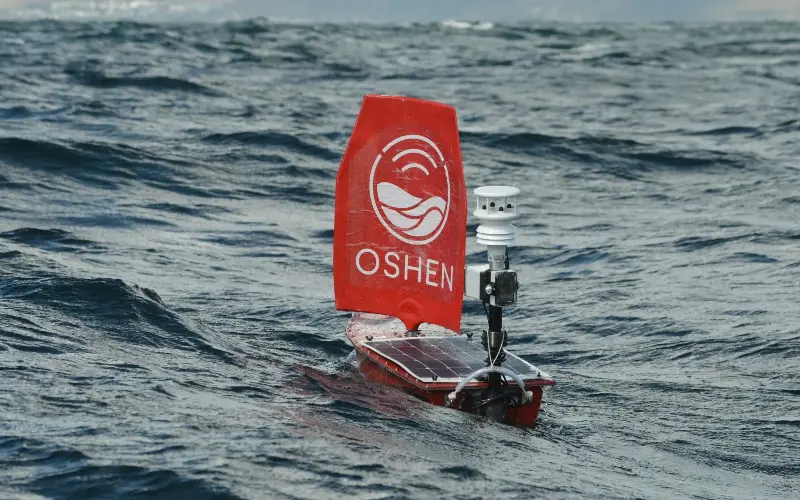
A robot sailing boat built in Plymouth has completed the first fully automated crossing of the Atlantic.
The Oshen C-Star PC13 is the first vessel to win the Microtransat Challenge prize, which was launched in 2010 but has taken 16 years to complete, despite dozens of attempts.
The tiny boat, which measures just 4ft long, set off from Gran Canaria on May 7. It battled through Tropical Storm Dolly and 30ft waves, before finally arriving at Barbados on Sunday.
It is the only uncrewed sailing vessel to have ever crossed the Atlantic, despite more than 30 previous attempts, including six by the US Naval Academy, and efforts by Shanghai University and the French Naval Academy.
Oshen succeeded on its third attempt, navigating busy shipping lanes to complete the 3,555-mile voyage in 127 days.
Anahita Laverack, the chief executive of Oshen, said: “We are thrilled to have finally completed the Microtransat. Even in the final hours, after so many days at sea, we weren’t certain that PC13 would reach the designated finishing zone.”
She added: “It also means a great deal personally: it was learning about the Microtransat Challenge, while at university, that set us on the path to creating Oshen.”
C-Star robotic vessels primarily navigate using the wind but also have a thruster powered by a solar panel for navigation in light winds. However, the Microtransat rules prohibited its use.
Before the challenge started, waypoints were plotted into the robot’s computer and the vessel was then left to its own devices to find the best way to reach those points using autonomous navigation software.
But it was not all plain sailing.
Ms Laverack added: “Near the midway point PC13 started steering erratically.
“We think this may have been to do with the rudder experiencing too much friction. However, the C-Star self-corrected and from then on navigated extremely well.”
Oshen’s C-Stars are primarily used as sensor platforms to gather oceanographic, climate and wildlife data, and can keep track of sea surface temperature, air temperature, air pressure and humidity, salinity and water density in remote areas of the ocean.
Category five hurricane
Last year, a C-Star was sent into Hurricane Humberto off the coast of the US Virgin Islands to monitor conditions in real time for the US National Oceanic and Atmospheric Administration (NOAA).
The boat survived for hours inside the eyewall of the hurricane – which was rated a category five, the most powerful and destructive, transmitting valuable live forecast data.
The Microtransat Challenge was founded in 2010 by Dr Mark Neal of Aberystwyth University and Dr Yves Briere of the Institut Supérieure de l’Aéronautique et de l’Espace, aiming to find the fastest time that a sailing boat could cross the Atlantic.
But the strict parameters meant that no boat had achieved it until now.
Entrants must make their way across the ocean entirely unassisted and once under way, teams cannot influence the vessel’s decision-making or change its course.
Boats must also be no more than 7ft 10in long, which limits the deck area for solar panels and the amount of power for onboard systems such as computers and thrusters.
Oshen’s first attempt in 2023 failed after just 20 days, when the boat had travelled just 6.2 miles. In 2024, the company tried again, managing to stay afloat 277 days, and getting three-quarters of the way across the Atlantic, before losing its sail in heavy seas.
However the gruelling journey allowed the company to design a boat that could handle the most extreme environments, with software which continually assesses wind speed and direction, currents and battery life, to hold position or sail themselves to pre-selected destinations.
The company has a constellation of boats in the Caribbean on an extended hurricane detection mission with the NOAA and next year the team is launching its biggest ever fleet to monitor climate tipping points in the North Atlantic.
“The bigger ambition is create permanent constellations – the ocean equivalent of a weather station and CCTV network, covering the parts of the ocean that have never had continuous monitoring,” added Ms Laverack.
In future the boats could also be fitted with hydrophones to be used for detecting illicit submarine activity and keeping a watch for sanctioned tankers or illegal fishing vessels sailing with their transponders switched off.