



There’s nothing like a spectacular Alpine panorama to trigger marital discord.
“Clearly it’s the one in the middle – must be the highest summit in the range,” my wife exclaimed. “Don’t be daft – that’s too far west,” I retorted. “And where are the three peaks? I reckon it’s third from left…”
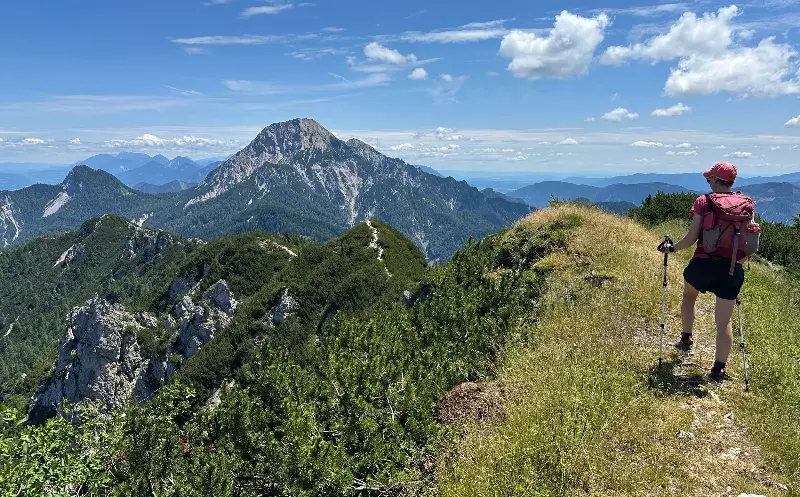
Viewed from our eyrie atop the Schwarzkogel, the gleaming Julian Alps lined up on the southern horizon like a troupe of thespians gathered for their last-night curtain call. But, as we munched our flaky, cheesy burek lunch, we realised that the star of the show was impossible to pick out. We couldn’t find Triglav.
In theory, Slovenia’s highest mountain – the famously triple-peaked 9,298ft behemoth (Triglav literally means “Three-Headed”) that adorns its national flag – should be easy enough to identify. In practice, though, it’s just one of dozens of magnificent summits standing shoulder to shoulder in its namesake national park. In this region, there are just too many mountains.
Finally, we agreed it was an ensemble hit. The supporting cast we’d admired over preceding days hiking the Alpe-Adria Circular Trail were barely less magnificent: the limestone peaks of the Carnic Alps and Karavanks, separating Slovenia from Austria.
The 6,043ft summit of the Schwarzkogel was the literal and metaphorical highpoint of our week-long walk, the compact little sibling of the 466-mile Alpe-Adria Trail weaving south from the Grossglockner, Austria’s tallest peak, through Slovenia and Italy to the Adriatic at Trieste. For those without a month to spare, the 83-mile loop offers a taster of the landscapes and overlapping cultures of this curious corner where three countries meet – though, thankfully, minus the hordes tramping the similarly tri-country Tour du Mont Blanc.
In the footsteps of the Romans
We started in Villach, in Austria’s southernmost state, Carinthia – more precisely, its hot-spring suburb Warmbad. With the mercury soaring above 30C, it was an easy choice to stroll straight past the space-age KärntenTherme spa (less so the 120-year-old spa patisserie, its counters piled with glistening tarts, gâteaux and strudels) to find the Holy Trinity Chapel from which the trail meanders.
And meander it did – surprisingly, as it followed a stretch of Roman road. On that torpid afternoon, when the air hung thick and sweet as treacle, we gratefully trodded two-millennia-old stone slabs of the Via Norica, grooved with the wheel prints of countless ancient carts, as it wound through shady woodland.
That day provided a gentle introduction. Our first mountain vistas were imposing rather than daunting, the pine-bewigged Dobratsch rising to our right as we followed the Gail Valley to Nötsch and its sister village, Feistritz. Here we were welcomed at the five-century-old Gasthof Alte Post with model Austrian hospitality, but intriguingly diverse culinary and cultural heritage, which reflected the region’s complex history.
The menu, for example, featured schnitzel and strudel but also Kasnudeln – a Carinthian take on ravioli. As we quaffed our Loncium lager, named for a nearby Roman mansio (service station), the young barman enthusiastically shared videos of the forthcoming Kufenstechen. In this folk event peculiar to the Gail Valley, young men riding hefty Noriker horses vie to smash a barrel with a club – a Slovenian tradition likely descended from Roman quintain games.
The borders between Italy, Austria and what’s now Slovenia – in large part the former Austro-Hungarian imperial region of Carniola – had shifted over time, notably after the First World War when the armistice handed swathes of Austria to Italy. And that’s where the trail led us next.
Taking flight
The sun was yet to peek above the southern ridge when we set out, following a mossy path past chattering cascades and across a covered wooden bridge, more reminiscent of Connecticut than Carinthia.
Then came the climb. Up a road past meadows purpled with chicory and scabious, serenaded by chaffinches, song-thrushes and blackcaps, up a forestry track lined with delicate spotted orchids, up past lumber piles and chapels and shrines, until finally we emerged onto a chocolate-box Alpine pasture: all wooden chalets and clanking cowbells.
Sitting at a nexus of foot and bike paths, Feistritzer Alm’s mountain hut bustled on that sunny Sunday. We nursed cappuccinos as gregarious walkers and cyclists ordered charcuterie boards and beers, and meadow pipits and paragliders wheeled overhead.
Revived, we ambled contentedly across the border, through meadows strewn with wildflowers and butterflies, and traced contour lines through pinewoods before descending steeply into the Saisera Valley. There we bedded down in the winsome village of Valbruna, guarded by the stegosaur spines of Jôf Fuart – a peak described by local mountaineering legend Julius Kugy as “a shimmering throne in the kingdom of light and joy”.
Settling into the familiar rhythm of long-distance hikes, each morning we girded loins for the inevitable ascent. From Valbruna we marched up switchbacks to Borgo Lussari, a photogenic hamlet straddling a wooded ridge; pilgrims have made the steep haul up a slippery path to venerate the Madonna del Lussari since that holy statue was discovered in the 1360s. Now a cable car whisks day-trippers (and, in winter, skiers) from the Valcanale below to indulge in pizza or cheese platters, and to browse the narrow, cobbled main drag for jams, stuffed toys and herb-infused liqueur.
Eschewing the modern escape route, we descended past blooming Alpenrose, goats and crosses, continuing along the whimsical and wonderfully shady “Gnome Path” to Tarvisio, a perky resort town beneath the Monte Mangart massif. Here, the Gelateria Dreiländereck provided another reminder of the area’s split personality: an Italian gelato café near the Slovenian border, its German name meaning “Three Countries Corner”.
A Tolkien-esque world
The next day saw us absorbing bear lore along the Sentiero dell’Orso – though my takeaway was: don’t get your hopes up, only about 10 roam Friuli-Venezia Giulia today. From whispering beechwoods we crossed meadows where a topless old fellow tossed hay with a wooden fork, before climbing again past a tellingly multilingual sign: Ai Laghi / Zum Seen / Jezero.
With their limpid teal-emerald waters reflecting jagged peaks, it’s no wonder the Fusine Lakes are hugely popular. Yet the enchantment of the shoreline trail is bulletproof: traversing a Tolkien-esque world, we hurdled bulbous roots and squeezed between lichen-daubed rocks.
Another sweaty ascent earned us a night at Rifugio Zacchi, a preternaturally perfect mountain hut where we sipped icy Aperol spritz on the panoramic terrace, before refuelling with a feast of local sausage, polenta, bacon-studded sauerkraut and frico – a kind of rösti, flavoured with fragrant Montasio cheese.
Having clambered up to La Porticina (Vratca Pass), a narrow cleft in the Carnic Alps yielding vistas east to Triglav and its neighbouring peaks, we descended into Slovenia and the resort town of Kranjska Gora. Today known for good-value skiing, its old core retains historic gems such as the Liznjek Homestead Museum, a 17th-century farmhouse restored to evoke rural life in centuries past.
The path back into Austria took us along the main Alpe-Adria route through the Karawanks, passing hardier hikers midway through their more epic trek south, along steep forest track past a succession of tumbling slaps (don’t you just love Slovenian?). On our approach to the Schwartzkogel, a snaking line of squat white posts delineated a border where, not four decades ago, the Iron Curtain was drawn tight. Today it’s wonderfully porous, and I delighted in tripping from one country to the other step by step.
Pausing at the Schwarzkogel’s summit cross, we gazed north into Austria and across the shimmering turquoise Faaker Lake, west to the Ponza Grande peak on the Italian border, and back south to Slovenia’s roof (probably. Maybe. Almost certainly.) Hopping between nations, we’d savoured tidbits from all three – and a blended heritage unique to this captivating corner.
How to do it
Walks Worldwide offers a self-guided, eight-day Alpe-Adria tri-country Trek from £895, including B&B, route notes, luggage transfers and three dinners. Fly to Venice or Trieste and transfer to Tarvisio or Villach. Or, travel by Eurostar to Amsterdam, Nightjet sleeper to Salzburg then domestic trains to Villach.