



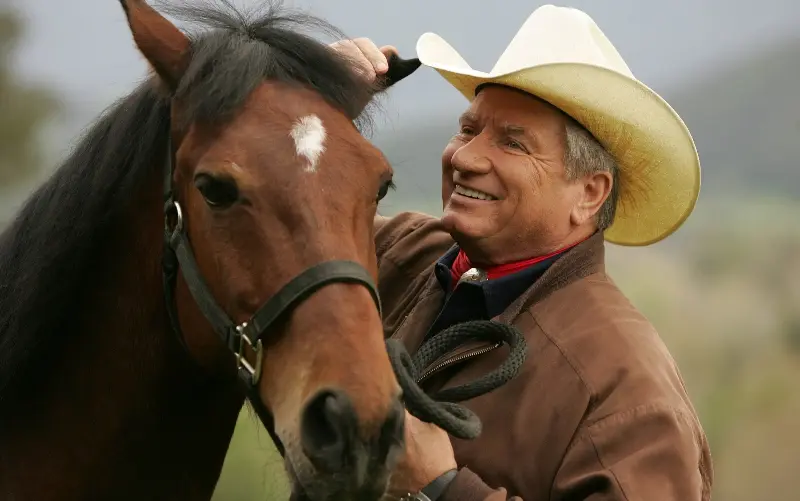
Monty Roberts, who has died aged 91, developed a reputation as an equestrian Pied Piper through his astonishing ability to tame the wildest and most recalcitrant horse in a matter of minutes; he was sometimes said to have inspired Nicholas Evans’s bestselling novel The Horse Whisperer (1995), which later became a film starring Robert Redford (1998).
Roberts based his methods on equine psychology and claimed to have learnt how to win a horse’s trust as a 13-year-old when he was employed by the California rodeo circuit to round up wild mustangs for their events. He would spend weeks at a time on horseback, following a single herd of mustangs, and he began to observe their behaviour.
He discovered that, contrary to popular belief, the leader of the herd is not a stallion, but the eldest and strongest mare, who punishes youthful misbehaviour by sending the miscreant away from the herd, keeping it at a distance by squaring up to and staring at the wrongdoer. In time, he noticed, the mare takes on a passive stance, dropping her head towards the ground and turning away – a signal that the miscreant has served its sentence and can return to the herd. When the horse returns, the mare then rewards it with grooming and attention.
Slowly, Roberts found he could predict from a horse’s behaviour and body language what the response would be from its companions: “As I watched the wild horses, I discovered they in fact communicate with a very sophisticated silent language. Every movement and position of the horse’s body has a meaning.” His interest turned to excitement when he found that he could evoke the same responses using his own body language and he began to wonder whether he could use the techniques to train horses through trust rather than “breaking” them with whips.
Though it was called “horse whispering”, the term is misleading as Roberts’s technique essentially involved non-verbal communication. By squaring his shoulders and shaking a long rope, he found he could “send away” an untrained horse within the confines of a pen. After several minutes of flight response, the horse would become confused and tired, providing cues that it wanted to return to the herd.
At this point Roberts would emulate the passive stance of a forgiving mare, inviting the horse over to him. Almost invariably, he found, the herd instinct would kick in and the horse would “join up”, recognising Roberts as its leader. Within a few more minutes, it was usually ready to accept bridle, saddle and rider.
Roberts’s extraordinary track record with difficult horses soon won a list of illustrious disciples. One of his greatest successes was Lomitas, a German-owned champion two-year-old who began refusing races after developing a phobia of the starting stalls. When, in May 1991, he was banned from racing “for life”, his despairing owners asked Roberts to help. After 10 days with Roberts, Lomitas went into the stalls like a lamb and won a race. He became a champion three-year-old and the highest-rated German racehorse in history.
Roberts himself went on to “start” (his term for “breaking in”) more than 145 winners, including Alleged, who won the Arc for Vincent O’Brien in 1977 and 1978. He predicted that horse racing would one day “all be whip-free, because we’re brighter than that”.
In Britain, Roberts was invited at the behest of the Royal family to work on some of their young racehorses. Subsequently Sir Henry Cecil, Sir Mark Prescott and the trainers for the Household Cavalry also adopted Roberts’s methods.
Yet his techniques remained controversial, partly because there were always suspicions that Roberts was not all he seemed. After the publication of his bestselling autobiography, The Man Who Listens to Horses (1996), in which he gave a harrowing account of the violent abuse he had suffered as a child from his father, critics, including members of his family, initiated a website and a book, Horse Whispers and Lies, dedicated to exposing his account as a fabrication.
Marvin Earl Roberts Jr was born on May 14 1935, and grew up on a horse ranch in Salinas, California. His father, a policeman, followed the family tradition as a part-time horse breaker. Young Monty was in the saddle as soon as he could walk and as a child he worked as a stunt double for child stars such as Roddy McDowall, Mickey Rooney, and Elizabeth Taylor in National Velvet.
By his own account, however, he became increasingly traumatised by the experience of watching his father beating horses into submission to “break” them. His father also, he claimed, turned the whip on him – and not only the whip, but chains and fists: “I had 71 broken bones before I was 12 years old. I was violated and beaten. I have permanent painful injuries from episodes that occurred when I was four and five years old,” he wrote in his autobiography. Some of his relatives, however, hotly disputed this account of his upbringing.
They also denied that he had spent time in the Nevada desert studying wild horses at 13 years old, claiming that the only wild horses Roberts came into contact with were those brought in each year for the rodeo in Salinas. Whatever the truth, there is little doubt that Roberts somehow worked out the dozens of secret signals horses use to communicate with each other.
Roberts claimed that at one public demonstration, an owner was seen hitting his horse with a pitchfork before sending it into the ring. Although the horse was difficult and visibly stressed, Roberts still managed to coax it to “join up”, telling the audience its behaviour was caused by brutality. He recalled that “as I spoke I could see the man’s little wife growing taller in her seat, until she called out: ‘You’re right. He abused that horse and he abused me.’”
Roberts eventually ran his own ranch in California, but his skill with horses remained an obscure and more or less private miracle until 1989, when he was invited by Queen Elizabeth II to come to England to work with her horses. “She believed that no one should ever say to any human being or animal, ‘You do what I tell you to do or I’ll hurt you,’” Roberts recalled in a 2022 interview. “When the Queen was with horses, she was a horse person. She didn’t want to be the Queen.”
In his autobiography, he also described how, after a session with one of the Queen Mother’s fillies, he was told by the horse’s effusive and visibly moved owner: “That was one of the most wonderful things I have ever seen in my life.” Instinctively he put out his arms to give her a hug, only to be stopped in his tracks by her security guards. The Queen Mother, he recalled, “did not seem in the least offended.”
His success with the royal string launched him as an international celebrity. Roberts hitched a ride on the phenomenal success of Nicholas Evans’s 1995 novel with his own autobiography, which sold more than four and a half million copies, and followed up with a tour of the United Kingdom. But he did not hesitate to speak out against the “Neanderthal” methods of the cowboys depicted in the novel and the film, and Evans himself denied that the horse whisperer of the book was based on him.
In the course of his career with horses, Roberts became convinced that his methods could, with suitable adaptations, equally well be applied to children. In addition to three children of their own, he and his wife Pat fostered 47 others, with, they claimed, notable success.
In 2000, a British teacher, Stephen Taylor, decided to introduce Roberts’s concepts to Kingshurst Junior School, Solihull, which had been condemned as failing by Ofsted. In under four years the school was reclassified as a centre of excellence, an achievement on the back of which Roberts developed a spin-off career as an educational adviser and keynote speaker at education and business conferences.
In 1999 Roberts published Shy Boy: The Horse that Came in from the Wild, about his adventures with a wild mustang.
In 2011 he was appointed an honorary MVO for services to the Queen’s racing establishment.
In 1956 he married Patricia Gail, his high-school sweetheart, who survives him with their three children.
Monty Roberts, born May 14 1935, died August 1 2026