


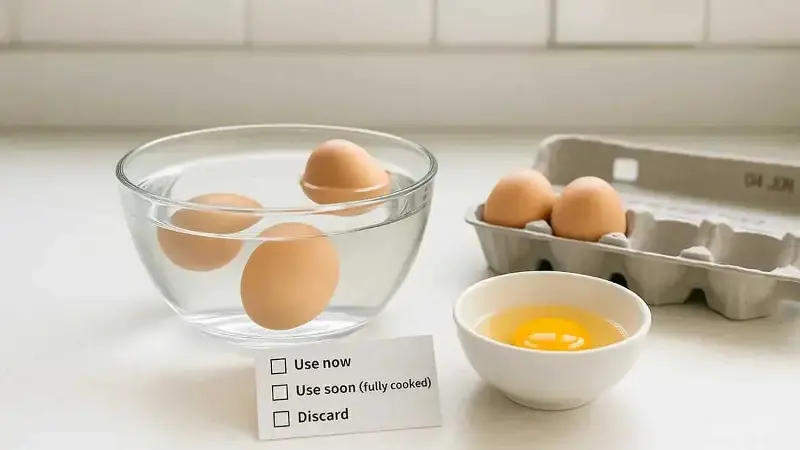
An egg can look calm and perfect in its shell—smooth, chalky, ordinary—right up until the moment it isn’t. The good news: you don’t need guesswork or internet folklore. In under two minutes, you can sort eggs into three buckets: use now, use soon (fully cooked), or discard.
Fast Promise + What The Tests Do Tell You
One-sentence promise: In minutes, you can sort eggs into use now / use soon (fully cooked) / discard—without overthinking carton dates.
What the tests can—and can’t—prove
- Float test: a freshness/age screen, not a guaranteed safety verdict.
- Crack + smell test: your best confirmation before cooking; odour is the hard stop.
- Safest default when uncertain: don’t use eggs raw or undercooked; choose fully cooked or discard if any red flags appear.
What you need
- A bowl of cold water
- Optional: a spoon (to lower eggs gently)
- A separate small bowl for cracking and inspecting
One-line why floating happens: as an egg ages, its internal air cell grows, making it more buoyant.
Checklist 1: The Float Test (Step-By-Step)
- Fill a bowl with cold water deep enough to fully cover an egg.
- Lower one egg at a time gently into the water (use a spoon if you’re rushing).
- Don’t drop or spin it—a hairline crack can muddy the result.
- Read the position after a few seconds.
Interpret the result → do this next
- Sinks and lies flat on its side
- Meaning: Freshest.
- Action: Best for poaching or other delicate cooks.
- Sinks but stands upright (pointing up)
- Meaning: Older, with a larger air pocket.
- Action: Use soon and prefer fully cooked dishes.
- Floats (any part breaks the surface)
- Meaning: Very old.
- Action: Go straight to the crack + smell test; discard if anything else seems off.
Caution: Floating alone doesn’t prove an egg is unsafe—it’s a signal to confirm before it touches your recipe.
Example (float test interpretation): An egg stands upright but doesn’t float → plan to use it soon in a fully cooked dish (scramble or baking), then crack-test first.
Quick tip to avoid mix-ups: return tested eggs to the carton right away, or mark the shell with a pencil dot.
Checklist 2: The Crack Test (Best Confirmation Before You Cook)
The moment the shell opens, the egg tells you the truth—sometimes in how the white spreads, sometimes instantly in the air.
The safest habit: crack into a separate bowl
- Crack each egg into a small bowl first, then add it to your main bowl or pan.
- Why it matters: one bad egg can ruin a full batter, and inspection is easier when the egg is alone.
Example (crack test protocol): When making cake, crack each egg into a small bowl first—then pour it into the mixer. One questionable egg stays isolated instead of spoiling the whole batch.
What to look for (quality cues vs. true alarms)
- Whites: thicker whites usually mean fresher; watery whites often mean older, not automatically spoiled.
- Yolk: a higher, rounder yolk tends to be fresher; a flatter yolk can indicate age.
- Spots: a small blood/meat spot can happen naturally; it’s not spoilage.
- Shell fragments: remove them now.
Smell test: one rule
- Any strong sulfur/rotten odor = discard immediately. Don’t taste-test and don’t try to “cook it off.”
If it looks borderline but doesn’t smell bad
- Use it only fully cooked (hard scramble, baked goods, fully set quiche).
- Skip raw/undercooked uses like homemade mayo, Caesar dressing, or runny yolks.
Explore egg recipes for fully cooked options
When To Throw Eggs Away: Clear Discard Triggers
Stop troubleshooting and discard if you hit any of these.
- Rotten/foul odour after cracking (hard stop).
- Visible mould (on shell or inside).
- Unusual colours in the contents (pink, green, or iridescent hues).
- Cracked shell with seepage (wetness or crusted, dried-on egg).
- Slimy/sticky residue on the shell, especially if you don’t know when it happened.
- Storage failures: left warm too long, repeatedly warmed/cooled, or unknown handling.
- Power outage uncertainty: if you can’t confidently confirm the eggs stayed cold, the safest choice is discard.
Reminder: If a discard trigger appears, don’t taste-test—discard and wash hands/tools; clean any surfaces that touched raw egg.
Storage Rules That Actually Keep Eggs Fresh Longer
- Keep eggs in the original carton. It protects shells, reduces odour absorption, and keeps date info together.
- Store in the coldest part of the fridge, not the door. Door shelves swing warmer with every open-close.
- Handling basics: wash hands after touching shells; keep shells dry; don’t wash eggs for storage (wipe just before use if needed).
- Freezing (quick waste-reducer): freeze beaten eggs (or separated whites/yolks) airtight; don’t freeze in-shell.
Carton dates: how to use them without wasting eggs
Cartons can show sell-by, best-by/best-before, or a pack date/code—and they don’t all mean “unsafe after this day.” Treat dates as planning tools, then let storage history + the crack/smell test make the final call.
- Sell-by: aimed at stores (stock rotation). If you’ve kept eggs consistently cold, they may still be usable after.
- Best-by/best-before: a quality estimate, not an automatic spoilage line.
- Pack date/code: tells when eggs were packed (helpful for comparing cartons), but you still need proper refrigeration.
Simple decision flow (fast + practical):
- Do you know they stayed refrigerated and handled normally? If no/unsure → safest choice is discard.
- If yes → if eggs are near/after the date, do a float test to gauge age.
- Before cooking (especially for baking or a big batch), crack into a separate bowl and smell.
- If there’s any off odour or visual red flag → discard. If not → use (and choose fully cooked when the egg seems older).
For general storage principles, you can also cross-check the USDA’s egg handling guidance (refrigeration slows spoilage and reduces risk): https://www.fsis.usda.gov/food-safety/safe-food-handling-and-preparation/eggs
| Test result | What it likely means | What to do next |
|---|---|---|
| Sinks and lies flat | Freshest | Use now; good for poaching/soft uses |
| Sinks but stands upright | Older | Use soon; prefer fully cooked; crack-test first |
| Floats | Very old | Crack into a bowl and smell; discard if any red flags |
Ask the Slurrp Community about egg date labels and storage quirks
Conclusion: The 3-Bucket Call
- Use now: the egg sinks flat, then cracks clean with no off smell.
- Use soon (fully cooked): the egg stands upright or the whites look looser, but it smells normal—cook it through.
- Discard: any rotten odour, mould/odd colours, leaks/slime, or a storage story you can’t trust.
If you’re stuck between “probably fine” and “I’m not sure,” don’t gamble on raw or runny eggs. Pick a fully cooked use—or throw it out and move on.
Some parts of this article were created with AI assistance.