



Most of us like a good old chat with friends, colleagues, neighbors or acquaintances. But what can turn a really good chat into a great one? Sure, conversation topics matter, but scientists have found underlying patterns that may explain our best interactions.
The question has long vexed scientists. Previous studies have mostly focused on how closely people's words and ideas match, rather than how chats flow and shift from one moment to the next.
But researchers Kathryn O'Nell, Emily Finn and Kiara L. Sanchez at Dartmouth College in the United States took a different approach.
The secret rhythm of conversations
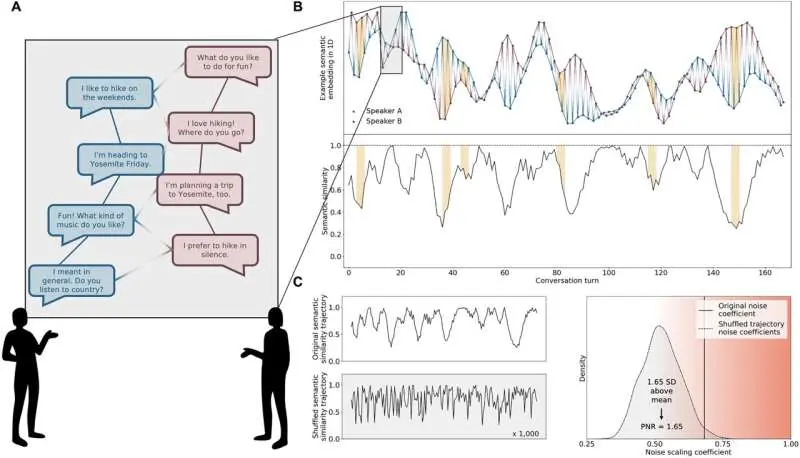
To better understand what makes a great chat, they investigated the possible role of pink noise. Now, this is not an audible background sound, but a mathematical pattern describing how changes occur over different timescales. Applied to conversations, it describes how speakers move between staying on the same wavelength and introducing new ideas, without becoming too predictable or losing track of each other's ideas.
The research team used a computational model to analyze thousands of real-life conversations between pairs of people. These included over 1,600 video calls between strangers, chats between friends, speed-dating conversations and public podcasts between co-hosts.
Next, they looked for pink noise in the conversations. To do this, they used an AI language model called MPNet to analyze the transcripts. The model converted each turn in the conversation into a numerical representation of its meaning, which allowed the researchers to measure how closely what one person said was related to what the other said next.
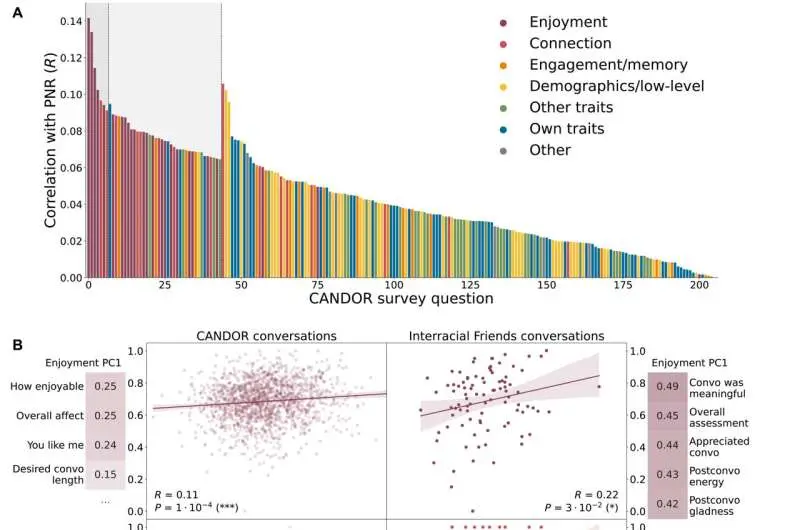
They then analyzed how this similarity changed throughout each conversation to look for pink noise. Having identified these patterns, the team investigated whether their strength was linked to how much people enjoyed their conversations and how connected they felt to each other.
Finding the conversational sweet spot
Their results, published in the journal Science Advances, suggest that a dose of pink noise could be one of the ingredients of a good conversation.
The researchers found that conversations with stronger pink noise patterns tended to be more enjoyable. Although the link was relatively small, this held true for chats between both strangers and friends.
In speed dating, pairs who both expressed an interest in seeing each other again had stronger pink noise patterns than those who didn't match. And when the researchers examined conversations between podcast co-hosts, they found that these patterns tended to grow stronger over their first 50 episodes together.
The findings suggest that a good conversation isn't just about what we say, but how we respond to each other. This includes moving between familiar ground and new ideas. However, the authors cautioned that their findings don't prove that pink noise actually makes conversations more enjoyable. "The main limitation of this work is that it is observational and correlational."
Written for you by our author Paul Arnold, edited by Gaby Clark, and fact-checked and reviewed by Robert Egan—this article is the result of careful human work. We rely on readers like you to keep independent science journalism alive. If this reporting matters to you, please consider a donation (especially monthly). You'll get an ad-free account as a thank-you.
Publication details
Kathryn C. O'Nell et al., Pink noise in dyads' semantic similarity trajectories predicts conversation enjoyment, Science Advances (2026). DOI: 10.1126/sciadv.aeb2684
Who's behind this story?

Paul Arnold
BSc Biology from University of London. BBC documentary producer with world travel experience. Freelances from southern Spain. Full profile →

Gaby Clark
MA in English, copy editor since 2021 with experience in higher education and health content. Dedicated to trustworthy science news. Full profile →

Robert Egan
Bachelor's in mathematical biology, Master's in creative writing. Well-traveled with unique perspectives on science and language. Full profile →
© 2026 Science X Network
Citation: The art of good conversation may involve a little pink noise (2026, November 9) retrieved 9 November 2026 from https://phys.org/news/2026-11-art-good-conversation-involve-pink.html
This document is subject to copyright. Apart from any fair dealing for the purpose of private study or research, no part may be reproduced without the written permission. The content is provided for information purposes only.