



Astronomers have discovered two early-universe galaxies where the central black holes appear to have grown far faster than their host galaxies. Observations with the James Webb Space Telescope (JWST) reveal that the black holes in these galaxies, seen just 800 million years after the Big Bang, are significantly more massive relative to their host galaxies, as opposed to what astronomers see in the nearby universe. The study is published on the arXiv preprint server.
Not-so gentle giants
Astronomers have long discovered quasars—extraordinarily luminous galaxies powered by accreting black holes weighing billions of solar masses—in the first billion years of the universe. For these to exist so early, the black holes must have started as large as heavy seeds and grown at their maximum rate possible for most of their lives. These early black holes appear oversized compared to the galaxies they live in.
On the other hand, when JWST began its operation in 2022, it made a huge splash in astronomy with the discovery of an astonishingly large number of mature galaxies and black holes in the first billion years of the universe. Among them were some "overmassive" black holes weighing billions of times the mass of our sun, but rarely as massive as those found in luminous quasars.
Astronomers suspect that some of these JWST-detected black holes could be a "missing link" between heavy seeds from the early universe and the luminous quasars observed later in the universe.
Test subjects
To test this idea, astronomers studied two such JWST-detected objects in a new study led by Romain A. Meyer from the University of Geneva. They reported the discovery of two ultra-luminous galaxies COLA1 and NEPLA4, as seen when the universe was only 800 million years old.
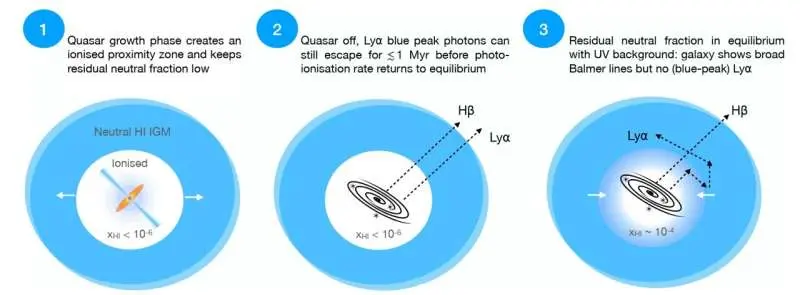
With JWST spectroscopy, astronomers detected broad hydrogen emission lines in both galaxies. These spectral lines are a telltale signature of gas swirling rapidly around a supermassive black hole. Both galaxies were found to emit a rare double-peaked signal of a type of light called Lyman-alpha—a feature that requires a large bubble of cleared, ionized gas surrounding the galaxy.
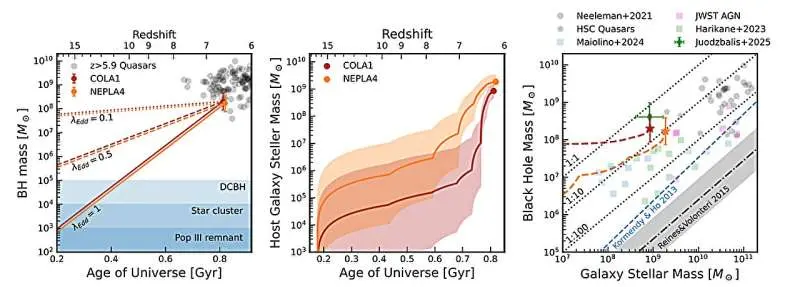
While not as massive as the billion-solar-mass black holes powering luminous quasars, these black holes weigh 170–190 million solar masses. They are also 400 to 800 times more massive relative to their host galaxies than what astronomers see in the nearby universe.
According to the researchers, they are among the most overmassive black holes found by JWST and bridge the black hole mass gap between the traditional categories of actively accreting black holes (also known as active galactic nuclei), galaxies, and luminous quasars at high redshift. This makes them strong candidates for the missing link astronomers have been searching for.
Post-quasar phase
Tracing their growth histories, astronomers found that to become a luminous quasar, these black holes must have been feeding at nearly their maximum possible rate since the universe was only 180–270 million years old. On the other hand, the majority of the galaxies' stars must have been formed only around 750 million years after the Big Bang. These findings suggest that black hole growth in the early universe may have outpaced galaxy formation.
The researchers propose that less than one million years before the current phase of COLA1 and NEPLA4, these black holes were feeding furiously as full-blown quasars. Their radiation was powerful enough to carve the large ionized bubbles, as supported by observations of a double-peaked Lyman-alpha signal. However, in the observed post-quasar phase, the situation has flipped. The black holes are dormant, feeding at a fraction of their maximum rate, while the galaxies are undergoing an intense burst of star formation.
If this star formation continues without being shut down again, both galaxies will gradually grow enough stellar mass to bring their outsized black hole-to-galaxy ratios back in line with what astronomers observe in the nearby universe.
"This recent inversion between stellar and BH mass assembly is consistent with the high BH-to-stellar mass ratio, and further implies that, provided star formation is not stopped, COLA1 and NEPLA4 will settle on the local BH-stellar mass on a quasi-horizontal track," the researchers explain in their paper.
The researchers note that combining JWST with powerful upcoming ground-based telescopes like the Extremely Large Telescope and Subaru could allow astronomers to systematically find more objects like COLA1 and NEPLA4. Building a larger sample would help them better understand quasars and their host galaxies and get a more accurate picture of the quasar's active and dormant phases in the first billion years of cosmic history.
Written for you by our author Shreejaya Karantha, edited by Gaby Clark, and fact-checked and reviewed by Robert Egan—this article is the result of careful human work. We rely on readers like you to keep independent science journalism alive. If this reporting matters to you, please consider a donation (especially monthly). You'll get an ad-free account as a thank-you.
Publication details
Romain A. Meyer et al, Life After the Quasar: Overmassive Black Holes and Remnant Ionised Bubbles in and Around Two z~6.6 Galaxies, arXiv (2026). DOI: 10.48550/arxiv.2605.00763
Journal information: arXiv



© 2026 Science X Network
Citation: JWST spots two early black holes growing far faster than their galaxies (2026, May 11) retrieved 11 May 2026 from https://phys.org/news/2026-05-jwst-early-black-holes-faster.html
This document is subject to copyright. Apart from any fair dealing for the purpose of private study or research, no part may be reproduced without the written permission. The content is provided for information purposes only.