



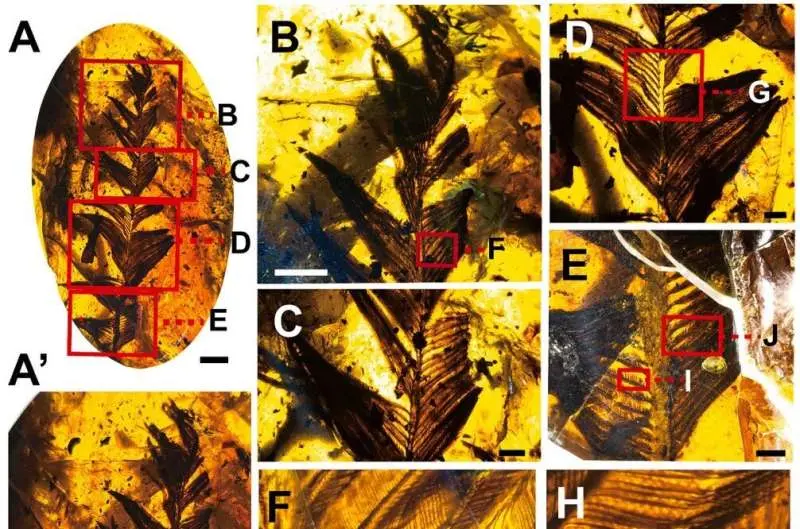
Long before birds took to the skies, dinosaurs were already sporting feathers. But exactly how they evolved into the sophisticated structures that allow birds to fly remains something of a mystery. Now, the discovery of the longest feather ever found preserved in amber is providing some new clues.
The feather belonged to an ancient dinosaur or early bird and became trapped in tree resin around 99 million years ago in what is now Myanmar. What makes it particularly valuable to scientists is that it has been preserved in three dimensions, allowing them to examine intricate structural details. Most fossil feathers flatten during fossilization, so many of these details are lost.
Clues trapped in amber
To see what it might reveal about early feather structure and flight, scientists led by Shuo Wang at East China Normal University in Shanghai examined the feather under a light microscope without removing it from the amber. However, they did extract two small samples for closer inspection under a scanning electron microscope.
Next, the team fed those measurements and other data into computer models. They then compared how a shaft modeled on the ancient feather and one with a modern-style design would respond to airflow.
The results, published in the journal Gondwana Research, help clarify the order in which feathers developed the features needed for flight.
Evolutionary timeline
The ancient feather looked surprisingly modern, but its internal structure told a different story. Although it was large and had a well-developed shape, its central shaft was unusually thin and lacked some of the internal structures that give modern feathers their strength. It was also missing the tiny hooks that hold the individual strands of a feather together. These help it withstand the forces of flight.
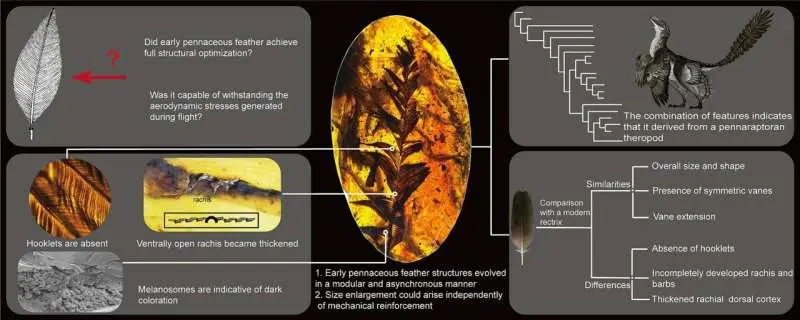
"These findings demonstrate that external resemblance to modern primary feathers does not necessarily imply equivalent mechanical performance in early pennaceous feathers [feathers with a central shaft and branches extending from either side]," wrote the researchers.
The computer simulations revealed another weakness. Under identical airflow conditions, a feather with a shaft modeled on the ancient specimen bent around 10 times more than one with a modern-style shaft.
When you put all these together, the findings suggest that feathers developed their size and elaborate shape before acquiring the strength and other structural features needed for effective flight. "Its morphology shows that major components of pennaceous feather construction did not arise simultaneously."
Written for you by our author Paul Arnold, edited by Gaby Clark, and fact-checked and reviewed by Robert Egan—this article is the result of careful human work. We rely on readers like you to keep independent science journalism alive. If this reporting matters to you, please consider a donation (especially monthly). You'll get an ad-free account as a thank-you.
Publication details
Yanyun Zhang et al., The longest 3D-preserved Cretaceous plumage reveals stepwise pennaceous feather evolution, Gondwana Research (2027). DOI: 10.1016/j.gr.2026.09.020
Who's behind this story?

Paul Arnold
BSc Biology from University of London. BBC documentary producer with world travel experience. Freelances from southern Spain. Full profile →

Gaby Clark
MA in English, copy editor since 2021 with experience in higher education and health content. Dedicated to trustworthy science news. Full profile →

Robert Egan
Bachelor's in mathematical biology, Master's in creative writing. Well-traveled with unique perspectives on science and language. Full profile →
© 2026 Science X Network
Citation: What a 99-million-year-old feather is telling us about the evolution of flight (2026, November 10) retrieved 10 November 2026 from https://phys.org/news/2026-11-million-year-feather-evolution-flight.html
This document is subject to copyright. Apart from any fair dealing for the purpose of private study or research, no part may be reproduced without the written permission. The content is provided for information purposes only.