


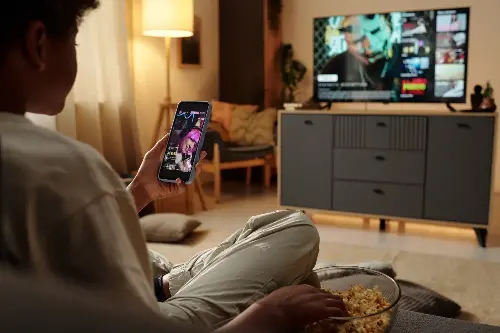
Double screening is now practically a national habit. If you catch yourself glancing from the TV to your phone and back again during your favourite show, you’re in very good company. Recent studies suggest as many as 80% of adults are using a smartphone or tablet while watching television. But is our ‘always on’ culture actually robbing us of the full TV experience? Or is it enhancing what we watch in exciting new ways? Let’s find out what we’re really missing in the age of double screens and whether our phones are actually making television better or worse.
The rise of double screening
Britain is one of the world’s biggest TV-loving nations, with the average adult tuning in for almost three hours a day. But the days of gathering around the telly, phone-free and fully focused, have nearly disappeared. Thanks to the lure of social media, messaging apps and instant info, the majority of us are now double-screeners—sometimes without even thinking about it.
According to Ofcom, nearly 71% of people admit to checking their device at least once during a typical TV session. The reasons are as varied as our schedules: some are chatting with friends about what’s on screen, others are quickly googling an unfamiliar actor, and plenty more are simply scrolling absentmindedly. Whatever the motive, the reality is clear—watching telly is rarely a solo activity for our brains anymore.
How your phone distracts—and sometimes improves—the show
Let’s be honest, even the best programmes have slow moments. Here’s where a phone can sneakily nudge its way in, offering instant relief from boredom. A tense drama scene? The temptation to check a message or reply on WhatsApp can win out, especially during slow dialogue or the obligatory ad break. University College London research has shown that our brains love novelty, so the buzz of breaking news or a group chat notification can distract us almost involuntarily.
But before phones take all the blame for our wandering attention spans, there’s an upside too. For many, double-screening makes TV more social and interactive. Live-tweeting your reactions, voting in reality TV polls, or joining fan communities online can turn a simple viewing into a full-blown event. Major televised moments like the ‘Love Island’ finale or a Eurovision performance are now immersive social experiences, as Twitter and Instagram light up with memes and play-by-play commentary.

What we’re missing: memory, immersion, and plot twists
The catch? All this multi-tasking comes at a cost. Neuroscientists have found that the brain is not as good at processing multiple streams of information as we like to think. When you’re checking your phone while the plot thickens, you’re likely to remember a lot less of what you watched. A study in the journal ‘Psychology of Popular Media’ found multitaskers performed 35% worse when recounting storylines than those who focused purely on the TV.
This means those clever plot twists, inside jokes, and intricate character arcs might just slip by unnoticed. You’re not just risking missing a major clue in a detective drama—you’re potentially diminishing the emotional payoff of the entire series. Even visual details, the kind directors painstakingly place for eagle-eyed viewers, can vanish from memory if your attention is split.
Does double-screening change what we watch?
Interestingly, double-screening is having an effect not only on our viewing habits, but also on the types of shows gaining popularity. Some genres, like reality TV and sport, practically thrive on second-screen interaction—producers often encourage viewers to live-vote or participate in real-time chats. Meanwhile, shows with fast-paced dialogue or dense plots are suffering, with audiences drifting off or missing crucial details.
In response, some streaming platforms have introduced ‘second-screen experiences’: apps that deliver complementary content, behind-the-scenes trivia or interactive quizzes in sync with the action on TV. While these can improve engagement, they also further fragment attention, making it even harder to stay immersed in the main show.
Finding a balance: making the most of both worlds
So, is your phone truly ruining your TV experience? Perhaps not, if you use it with intention. The key might be mindful watching: choosing the shows where you want to dive in completely (and setting your phone aside), versus those you watch for light entertainment while chatting or scrolling. Next time you’re settling in for a gripping drama or the season finale of your favourite series, consider putting your device out of reach—you might be surprised at how much more you see, hear and feel.
But don’t feel guilty for enjoying the communal aspect of double-screening, either. For many, the social buzz around television is half the fun. Ultimately, being aware of when and why you reach for your phone makes all the difference. In an age of endless digital distractions, sometimes the best way to enjoy a show is to simply give it—and yourself—the gift of undivided attention.