



New Delhi
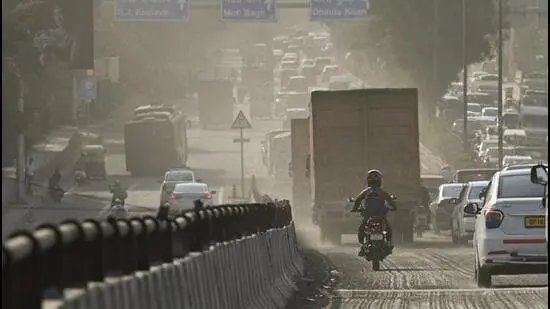
Dust from pothole-riddled or dilapidated stretches of an 82.5-kilometre corridor from Mayapuri to Punjabi Bagh, passing through National Highway 44 (NH-44) and NH-9, has emerged as a major pollution source, according to a study carried out by CSIR-NEERI and the Central Road Research Institute at the behest of the Commission for Air Quality Management (CAQM).
The study was conducted from May 2022 to June 2023, and published in February 2025, but was not made public. Pointing out that only 34% of the corridor was in good condition, with the remaining 66% in moderate to poor condition, it estimated vehicular movement generating 33.8 tonne/day of particulate matter having a diameter of 10 microns or less (PM10) and 8.16 tonne/day of PM2.5. At hot spots, such as the Ghevra to Punjabi Bagh stretch, the PM10 level peaked to 1450.5kg/day/km.
“The stretch from Ghevra to Punjabi Bagh West road (NH-9) shows alarmingly high levels of PM 10 and PM 2.5 emissions with values of 1450.5 kg/day/km and 349.5 kg/day/km respectively, which are significantly very high for any city roads. Bawana to Ghevra metro (NH-9) also exhibits elevated PM levels, with PM 10 at 834.9 kg/day/km and PM 2.5 at 202.0 kg/day/km,” the study said.
Delhi struggles with a problem of pollution due to a combination of factors, including meteorology and vehicular emissions. In this context, these ultrafine PM2.5 and PM10 particles are major contributors to pollution as they can easily enter deep inside the lungs and cause coughing or breathing difficulty in the short term, and respiratory diseases and cancer in the longer term, as per experts.
The study found dust concentrated along road edges and medians, exacerbated by unpaved shoulders, construction waste and poor maintenance. It recommended paving shoulders, using mechanised sweeping, dust suppressants, and targeted plantation using treated wastewater to curb emissions.
Researchers observed that dust was not uniformly distributed, but largely accumulated within 0.5 to 2 metres of road edges and medians—spots that are rarely cleaned effectively, making it highly susceptible to re-suspension by passing vehicles, especially heavy-duty traffic. Peak emissions were observed during the rush hours, when traffic volume and speed variations combine to maximise dust lift-off.
As part of the study, dust particles were also passed through a sieve to assess the sizes of dust and the correlation to re-suspension. The finding indicated that around 50% of the sampled dust collected from five different locations along the selected road was passed through a 178µm sieve to assess particle size.
“The road stretch between Tikri Border and Mundka has a high percentage of dust deposition whose particle diameter is ≤176 µm on roads, followed by Mukarba Chowk, Mayapuri, Azadpur and Narela. This might be due to a combination of factors, i.e. poor condition of roads, irregular maintenance of roads and insufficient dust management practices. Implementation of suitable dust control options will reduce the high dust loading from these locations,” the study said, adding the dust volume percentage of dust particles of size ≤76 µm and ≤10 µm were found in the range of 13.6%-42.68% and 1.2%-3.7%, respectively.
“The dust particles below ≤76 µm are considered as silt mass, which is being re-suspended in the ambient due to vehicle’s movement,” it read.
A CAQM official said the goal of the study was to identify problems and assess the best global practices to tackle road dust. “Based on this, we have formulated a standard framework for roads in NCR. This has been shared with the NCR states already,” the official said.
In terms of solutions, the study calls for a shift from reactive cleaning to preventive and engineering-led interventions.
“Dust generation can be minimized by improving the road maintenance practices. This involves things like fixing potholes, sweeping the road surface, developing green spaces on median or edges, clean drainage system and removing loose gravel from road sides,” it said, stating basic interventions like paving the unpaved road shoulders will reduce the potential dust generation at hot spots.
On February 24, Union environment minister Bhupender Yadav presided over the signing of four MoUs to roll out a Standard Framework and Road Asset Management System (RAMS) across Delhi-NCR to tackle road dust – a key contributor to PM10 pollution. The Delhi government is, meanwhile, planning to make nearly 1,500 roads in the capital, covering over 2,700km “dust-free” by the end of 2026, according to its state action plan on air pollution submitted to the CAQM earlier this year.
Experts say tackling road dust will go a long way in tackling PM10 emissions. “The problem, first and foremost, with our roads is poor quality of the materials used and thus, they do not last long. Our roads are filled with potholes and poor coordination between agencies means the same roads are dug up and repaired multiple times,” said Dipankar Saha, former head of the Central Pollution Control Board’s air laboratory.