



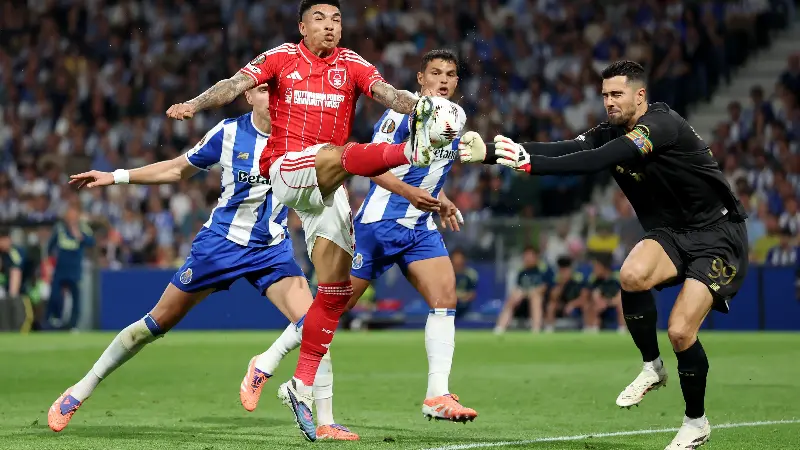
Nottingham Forest secured a hard-fought 1-1 draw at the Estadio do Dragao despite being significantly out-shot by their hosts. A bizarre own goal from Martim Fernandes cancelled out an early strike from Porto's Wendel Gomes in a statistically lopsided encounter.
The Europa League clash at the Estadio do Dragao delivered a result that defied the underlying metrics. FC Porto dominated large periods of the match, controlling 52% of possession and generating an Expected Goals (xG) value of 1.92 compared to Nottingham Forest's meagre 0.26. Despite this statistical superiority and firing 14 shots toward the visitors' goal, the Portuguese giants were forced to settle for a point after a moment of defensive misfortune.
For Nottingham Forest, the 1-1 outcome represents a triumph of defensive resilience over offensive output. Missing key personnel like Brennan Johnson and Morgan Gibbs-White for parts of the second half after substitutions, the English side relied on a disciplined backline that recorded 31 clearances and 13 interceptions. While they struggled to create meaningful chances of their own, their ability to frustrate Porto's high-volume shooting ensured they remained 13th in the table, staying firmly in the hunt for the knockout stages.
1. Porto's finishing inefficiency proves costly
FC Porto will view this as two points dropped rather than one gained. Mathematically, Francesco Farioli's side did enough to win the match twice over. With 14 total shots and eight finds on target, Porto maintained a constant threat, yet they only managed to beat the Forest goalkeeper once through Wendel Gomes in the 11th minute. The discrepancy between their 1.92 xG and their solitary goal highlights a clinical deficit that haunted them throughout the 90 minutes. When playing at this level, failing to convert 57% of on-target efforts into goals often invites the kind of statistical anomaly that occurred with the equaliser.
2. The Martim Fernandes own goal was a statistical outlier
The equaliser, credited as a Martim Fernandes own goal in the 13th minute, completely altered the complexion of the tie. From a data perspective, Nottingham Forest managed just two shots on target all evening, amassing a tiny xG of 0.26. The fact they left Portugal with a goal and a point is largely down to this high-variance event. Own goals are often the results of sustained pressure, but in this instance, it served as a lifeline for a Forest side that was otherwise struggling to penetrate Porto's defensive third. For Fernandes, the error was a rare blot on a night where Porto otherwise limited Forest to very few high-quality entries.
3. Forest's defensive volume outweighed Porto's creativity
Vitor Pereira’s tactical approach was validated by the sheer volume of defensive actions his side produced. Nottingham Forest were forced into 31 clearances and 13 interceptions to keep Porto at bay. While Porto attempted 19 crosses and earned five corners, Forest's back three—led in spirit by the resilient Murillo and Morato—showed excellent spatial awareness. This reactive style of play surrendered the initiative, but the data shows Forest won the majority of the crucial duels in their own penalty area. By forcing Porto into speculative shots that resulted in seven saves for the visitors' keeper, Forest successfully turned a siege into a stalemate.
4. Set-piece opportunities went largely underutilised
Despite the physical profile of both squads, set-pieces failed to provide the breakthrough. Porto earned five corners to Forest's two, yet neither side looked particularly threatening from dead-ball situations. Porto's 19 crosses resulted in very few clear-cut headed opportunities, as reflected by the fact they only won six aerial challenges throughout the match. For a side with Porto's technical quality, the failure to convert corner-kick volume into high-value xG chances is an area Farioli will likely scrutinise. Forest, similarly, were unable to leverage Chris Wood's presence before his half-time withdrawal, failing to register a single shot from a set-play secondary phase.
5. Substitutions failed to break the tactical deadlock
Both managers turned to their benches in the second half to find a winner, but the tactical structure of the game remained rigid. Farioli introduced the likes of Deniz Gul and Pepe in the 58th minute to refresh the attack, while Pereira brought on Neco Williams and Omari Hutchinson to provide counter-attacking pace. However, the second-half data shows a decline in shot quality for both teams. Forest’s decision to replace Chris Wood at half-time shifted them into a more mobile but less physical attacking shape, which Porto’s defenders comfortable marshalled. The match reached a stalemate where neither side’s bench could significantly tilt the xG momentum in the final 20 minutes.
Conclusion
This 1-1 draw was a classic case of defensive persistence negating offensive volume. FC Porto’s 1.92 xG and eight shots on target demonstrated their creative capacity, but their lack of a clinical edge and a freak own goal handed Nottingham Forest an improbable route back into the game. Forest will be delighted with a point earned from just 0.26 xG, proving that in European competition, defensive structure and a touch of fortune can often outweigh statistical dominance.