


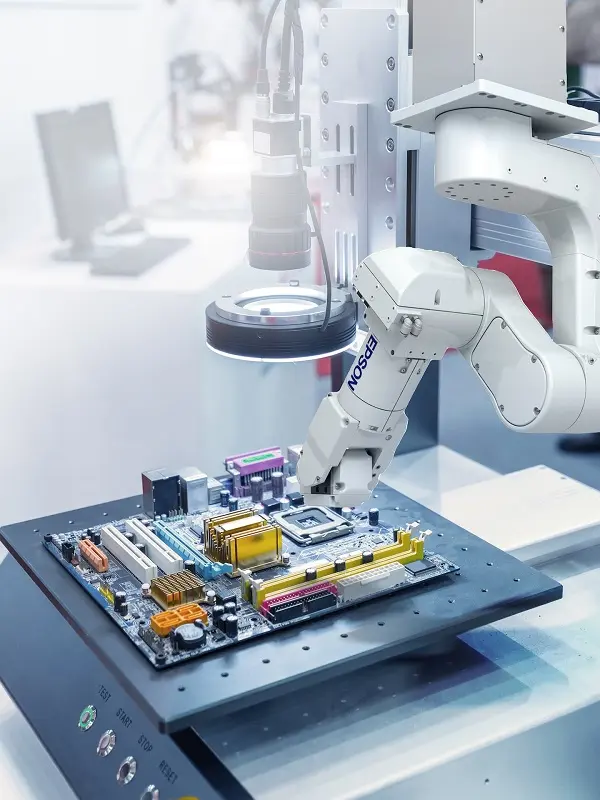
As manufacturers continue to automate production, improving output without compromising quality remains one of the industry’s biggest challenges. Faster production lines can increase efficiency, but higher operating speeds also introduce vibration that may affect accuracy, consistency, and product quality.
For manufacturers operating in industries where even the smallest deviation can have significant consequences, maintaining precision at high speeds has become increasingly important.
Meeting the Demands of Modern Manufacturing
The need for more precise automation is becoming increasingly relevant in the Philippines, particularly in industries such as electronics manufacturing, semiconductor assembly and testing, medical devices, and automotive components that continue to support the country’s export sector.
As manufacturers look for ways to improve productivity while remaining competitive, technologies that enhance both speed and accuracy are becoming more valuable.
To address this challenge, Epson is drawing on decades of expertise in quartz technology and precision engineering to develop robotic solutions that help manufacturers improve efficiency without sacrificing quality.
Using Quartz Technology to Reduce Vibration
Best known for developing the world’s first analog quartz watch, Epson has adapted the same principles of precision for industrial automation through its proprietary ultra-compact gyro sensors.
Using quartz crystal technology together with the company’s micro-electromechanical systems (MEMS) manufacturing process, the sensors are capable of detecting even small vibrations in real time. Installed directly on the tip of a robot arm, they continuously monitor movement and provide feedback to the robot’s control system.
According to Epson, this enables robots to compensate automatically for unwanted vibration, helping maintain positioning accuracy during high-speed operations. Reducing vibration can improve production accuracy, minimize defects, and increase productivity while maintaining product quality.
Applications Across Industries
The technology is particularly suited to manufacturing environments where precision is essential.
In electronics manufacturing, robots routinely handle miniature components that require accurate placement. Even slight movement can affect assembly quality. Medical device manufacturers likewise depend on repeatable, consistent production processes to meet stringent quality requirements.
High-volume applications such as packaging and assembly can also benefit from reduced vibration by minimizing errors, lowering downtime, and improving overall operational efficiency.
By addressing a common limitation of automated production systems, Epson says its technology helps manufacturers maximize production performance while maintaining product quality.
“Manufacturers today are looking for ways to increase productivity without compromising quality,” said Masako Kusama, president and director of Epson Philippines Corporation. “Through our expertise in quartz technology and robotics, Epson is helping businesses overcome this challenge by improving precision, reducing errors, and enabling more efficient production processes. Our goal is to help manufacturers achieve better outcomes while making the most of their resources.”
Advancing Precision Robotics
Beyond vibration control, Epson is also developing force-sensing technologies that allow robots to perform delicate tasks with greater precision.
Available on selected SCARA and 6-axis robots, these sensors enable robotic systems to detect pressure and make real-time adjustments when handling fragile components or carrying out precision assembly work.
Together, Epson says its vibration-control and force-sensing technologies help improve manufacturing quality, consistency, and operational efficiency.
“Precision has always been at the core of everything Epson builds,” Kusama added. “As more businesses in the Philippines explore automation, our goal is to provide practical and reliable solutions that help address real manufacturing challenges while supporting long-term growth.”
Through continued developments in robotics, sensing technologies, and precision engineering, Epson remains focused on helping manufacturers improve productivity while maintaining the accuracy and consistency required in today’s manufacturing environment.
To learn more about Epson’s precision robotics and automation solutions, visit www.epson.com.ph.