



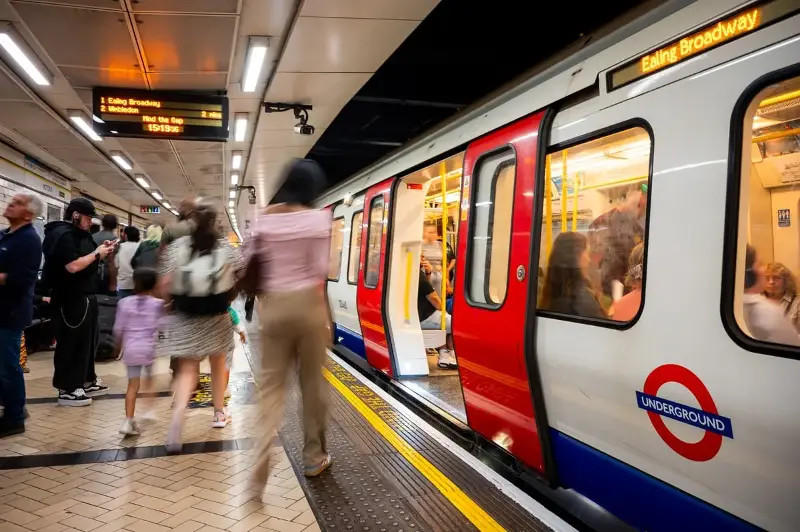
London is to be blighted by Tube strikes this week after the RMT union “instructed” train drivers not to go to work.
The union announced it was pressing ahead with planned 24-hour walkouts by drivers on Tuesday, June 2 and Thursday, June 4.
The grim news for London commuters, tourists and other Underground users came after eleventh-hour talks on Monday between London Underground and RMT officials at the conciliatory service Acas failed to find a compromise agreement.
Despite the RMT industrial action, services are expected to run on most Tube lines though disruption is likely.
There will be limited service on strike days before 6.30am and customers should complete their journeys by 9pm, Transport for London (TfL) has warned.
No service is expected on the Circle line, Piccadilly line, the Metropolitan line between Baker Street and Aldgate, and the Central line between White City and Liverpool Street.
Other services, including the Elizabeth line, tram, London Overground and DLR will run as scheduled but are expected to be busier than normal.
Underground services could also be hit the days after the walkouts due to the knock-on effect.
Tube users are being urged to plan their journeys before they travel on strike days using London’s official travel app, TfL Go, or through the TfL website.
In a memo sent out on Friday to RMT members, the union’s general secretary Eddie Dempsey “instructed” Tube drivers, who earn around £74,000 a year, not to turn up to work on the two strike days in the row over a proposed four-day week.
He also gave an insight into a power battle that the RMT is engaged in with London Underground over future talks in which the union does not believe it is being given enough say.
Transport for London has stressed that the new working arrangements are voluntary and that they aim to improve the work-life balance of drivers while enhancing the reliability of services.
In an attempt to resolve the stand-off, TfL gave new reassurances in recent days that the deal on offer would remain voluntary and that no driver would be forced to move to a four-day week.
The RMT previously branded the proposed new working conditions as a “fake” four-day week, suggesting it was compressing five days into four, and that it would lead to more fatigue among drivers who could be given their shifts at short notice.
But its position was seriously undermined by the Aslef train drivers’ union backing the TfL deal and describing it as offering the best working conditions on the mainline rail network.
Finn Brennan, Aslef district organiser for the Tube, emphasised to its members: "The introduction of the four-day week will be the biggest improvement in working conditions for Underground train drivers in decades.”
Benefits of the deal highlighted by Aslef to its members include an extra 35 days away from work a year, average weekly rostered hours being cut to 34 from current average of 36, as well as more time at home and less time travelling to and from work, meaning less fatigue and giving drivers a better quality of life.
There are also signs that the latest series of RMT strikes may not be as strongly supported as previous industrial action.
More than half of services ran on the Tube during the walkouts in April, with some RMT drivers turning up to work.
Strikes planned for May were called off.
© The Standard Ltd