


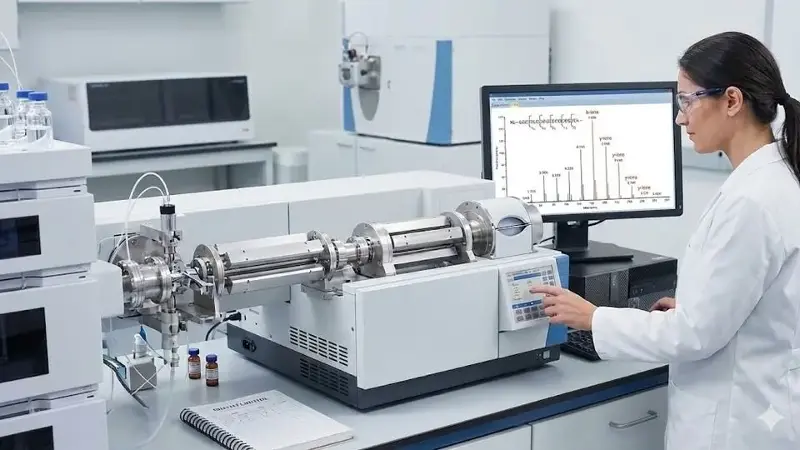
India, Aug. 1 -- Not long ago, mass spectrometry was regarded as a highly specialised technology found primarily in elite research laboratories and pharmaceutical R&D centres. Today, it is quietly becoming one of the most influential tools shaping modern science. From decoding complex proteins and detecting trace contaminants in food to enabling precision cancer diagnostics and ensuring the quality of biologics, mass spectrometry has moved far beyond the laboratory bench to become a critical enabler of healthcare, biotechnology and industrial innovation.
Its role is expanding just as science itself is becoming more data-intensive. When Thermo Fisher Scientific announced its collaboration with OpenAI to integrate artificial intelligence across its scientific instruments and digital ecosystem, it signalled that the future of mass spectrometry would be shaped as much by intelligent software as by advances in hardware.
Around the same time, the launch of the FAIR-MS initiative by mzio GmbH, in collaboration with SCIEX, Waters, Agilent and Bruker, marked another watershed moment by enabling artificial intelligence to unlock and compare decades of archived mass spectrometry data across laboratories and instrument platforms. Together, these developments point to a profound shift in analytical science: from simply generating data to transforming it into actionable knowledge.
This convergence of scientific innovation, digital transformation and industrial demand is fuelling remarkable market growth. According to Grand View Research estimate, India's mass spectrometry market generated approximately $337.5 million in 2025 and is projected to more than double to $718.5 million by 2033, growing at a CAGR of 9.7 per cent, well above the projected global growth rate. This reflects rising investments in pharmaceutical R&D, biosimilars, clinical diagnostics, food safety, and environmental testing.
India is rapidly emerging as one of the industry's most promising growth markets. Backed by a thriving pharmaceutical sector, expanding biosimilar manufacturing, stronger food safety regulations and increasing investments in research infrastructure, the country is steadily building the analytical capabilities needed to support next-generation healthcare and biotechnology.
From internationally recognised per- and polyfluoroalkyl substances (PFAS) research at the Council of Scientific & Industrial Research -Indian Institute of Toxicology Research (CSIR-IITR) in Lucknow and new clinical mass spectrometry facilities at leading hospitals to expanded investments by global technology companies, India is evolving from a fast-growing customer base into an increasingly influential contributor to the future of mass spectrometry.
"India is a pivotal market for advanced analytical technologies, with strong demand for mass spectrometry driven by the increasing scale and sophistication of pharma and biopharma innovation," says Nandakumar Kalathil, Country General Manager - India, Agilent Technologies. "As one of the world's leading producers of generic medicines and an increasingly important hub for biologics and biosimilars, India is investing in advanced analytical capabilities to meet innovation needs and global regulatory standards."
The Technology Revolution: AI, Miniaturisation, and the Software Turn
If the past decade was about increasing the sensitivity and resolution of mass spectrometers, the current era is defined by intelligence, efficiency, and accessibility.
Artificial intelligence is no longer a futuristic add-on, it is rapidly becoming integral to instrument design. Shimadzu's latest LCMS-8065XE, showcased at ASMS 2026, features an AI Performance Concierge for predictive maintenance and a Peakintelligence module for automated peak detection, claiming a 67 per cent reduction in manual data review time. SCIEX's new novus V55, also launched at ASMS 2026, ships with SCIEX OS 5.0 software featuring a natural language AI help function and AI-driven Calculated Columns. Thermo Fisher has formalised a strategic collaboration with OpenAI to embed artificial intelligence across its entire product and services ecosystem.
In parallel, a cross-vendor initiative is emerging to democratise historical MS data. At ASMS 2026, mzio GmbH announced the launch of FAIR-MS, developed with SCIEX, Waters, Agilent, and Bruker, to apply AI to the reuse and comparative analysis of archived mass spectrometry datasets across instruments and laboratories. It is perhaps the clearest signal yet that the industry is shifting from hardware competition to data ecosystem competition.
Miniaturisation and portability are equally transformative. New compact and field-deployable systems are enabling on-site testing in clinical, environmental, and forensic settings without sacrificing analytical rigor. Sustainability, once an afterthought, has become a real procurement criterion: the SCIEX novus V55 offers a 35 per cent smaller footprint and 40 per cent reductions in energy consumption, while Shimadzu's LCMS-8065XE claims 63 per cent lower running costs than competing systems. With laboratories facing constrained budgets, grid capacity limits, and green procurement mandates, this is not merely marketing, it reflects genuine market pressure.
On the software side, the segment is expected to grow at the highest CAGR of 9.6 per cent through 2031, as demand for integrated data management, AI-powered spectral analysis, and compliance-ready workflows eclipses growth in hardware alone.
Global Instrument Launches: A Wave of Innovation
The pace of new product introductions underscores the dynamism of the sector. At ASMS 2025, Thermo Fisher unveiled the Orbitrap Astral Zoom, building on its predecessor with 30 per cent faster scan speeds, 40 per cent higher throughput, and 50 per cent expanded multiplexing capabilities, alongside the Orbitrap Excedion Pro for precision proteoform analysis. Waters launched the Xevo TQ Absolute XR at the same conference, its most sensitive benchtop tandem quadrupole yet, designed for pharmaceutical quantitation and PFAS detection, consuming up to 50 per cent less power and occupying up to 50 per cent less bench space than comparable instruments. By ASMS 2026, Waters raised the bar again with the Xevo MRT P10, a high-resolution QTof system delivering up to 20x higher MS/MS sensitivity and 2x faster acquisition than its predecessor.
Bruker's timsOmni platform, launched in 2025, has ushered in a new era for functional proteomics and proteoform sequencing. At ASMS 2026, the company introduced the timsMRMS, combining trapped ion mobility spectrometry with magnetic resonance mass spectrometry, a significant step toward higher-order structural analysis at scale. SCIEX's novus V55 represents the fifth generation of its triple quadrupole lineage, redesigned from the ground up based on direct customer feedback prioritising throughput, footprint, and power efficiency. Agilent's InfinityLab Pro iQ Series rounds out a field of instruments pushing simultaneously toward greater intelligence, smaller size, and lower operational cost.
The LC-MS segment continues to dominate the market with a 57.5 per cent share, while ICP-MS is the fastest-growing technology type, driven by surging demand for ultra-trace elemental analysis in pharmaceutical purity testing, heavy metal detection in food safety, and environmental contaminant monitoring.
Multi-Omics: The Convergence Reshaping Discovery
Underlying much of this instrument-level innovation is a deeper scientific shift: the move from single-technique analysis to integrated, systems-level biology. "Biological systems are regulated through strongly interconnected molecular layers that cannot be accurately resolved using single-omics approaches," says Dr Rajendra Kumar Jadi, Assistant Professor at the School of Pharmacy, Anurag University, Hyderabad. "Mass spectrometry (MS)-based multi-omics integration is recognised as a central analytical strategy by enabling direct, high-resolution measurement of proteins, metabolites, and lipids, thereby supporting systems-level biological interpretation and translational discovery." He points to cancer biology, metabolic disorders, neurodegenerative diseases, and environmental research as areas where this approach has already improved biomarker robustness and mechanistic resolution, and expects continued advances in instrumentation, acquisition strategies, and computational integration to further sharpen biological interpretability.
That view is echoed from a clinical vantage point by Akhilesh Pandey, M.D., Ph.D., of the Department of Laboratory Medicine and Pathology at Mayo Clinic, Rochester, USA. He notes, "Mass spectrometry is increasingly becoming a cornerstone of precision medicine as it converges with genomics, proteomics, metabolomics, and other omics technologies." Pandey points to a 2025 review in the Orphanet Journal of Rare Diseases, which found that integrating these multi-omics approaches offers deeper insight into disease biology, supporting more accurate diagnoses, biomarker discovery, and personalised therapies. "The technology is expanding beyond research into clinical practice itself- into newborn screening, disease diagnostics, and therapeutic monitoring, even as challenges around standardisation and accessibility remain, with high-resolution instruments, LC-MS/MS, and AI-driven data analysis accelerating adoption across healthcare and biomedical research," he added.
A key trend shaping platform design, according to Kalathil, is the growing complexity of the molecules being analysed. "A key trend is the focus on complex biologics and precision medicine, requiring high-sensitivity, accurate-mass technologies for end-to-end molecular characterisation," he says. "This is driving the adoption of advanced MS platforms and application-specific workflows. Increasingly, customers are looking not just for instrumentation, but for complete, validated workflows that can accelerate development timelines while ensuring global compliance."
That shift toward integration is reshaping what customers expect from vendors. "At the same time, there is a shift toward integrated, workflow-based solutions, especially among CROs, CDMOs, and fast-scaling pharma companies: to improve productivity and ensure compliance," Kalathil notes. "We are seeing this play out in areas such as biopharma characterisation and impurity profiling, where integrated LC-MS workflows are becoming critical for consistent, reproducible outcomes across labs. We are also seeing the rising adoption of high-throughput systems, automation, and connected digital labs. This convergence of automation and informatics is helping laboratories move toward more predictive and insight-driven operations."
India: Regulation, Research, and a Rising Role
In India's mass spectrometry market, the most significant structural change is regulatory. In December 2025, the Food Safety and Standards Authority of India (FSSAI) finalised technical specifications for high-end equipment including GC-MS/MS, LC-MS/MS, and ICP-MS, standardising instrumentation across the country's National Food Laboratories. This single regulatory action is expected to drive a wave of procurement activity across government labs. Reinforcing this, FSSAI from January 2026 now mandates that food safety reviews be backed by scientific data, including toxicological studies and India-specific consumption evidence, a framework that will require robust analytical infrastructure.
On the research front, India's most prominent mass spectrometry story in 2025-26 has come from CSIR-IITR in Lucknow. The institute has been building detection capabilities for PFAS or "forever chemicals", using Waters' advanced LC-MS technologies, with a mandate to generate the nationwide data required for regulatory limits to be set. This work earned the Analytical Science Article of the Year at the 2026 SelectScience Scientists' Choice Awards, presented at ASMS 2026. The recognition placed India's MS research capability on the global stage.
On the industry side, global majors are deepening their India commitments. Thermo Fisher Scientific opened a new Bioprocess Design Center in Hyderabad in late 2025 as part of its Asia-wide biopharma infrastructure buildout, adding to an existing footprint of eight manufacturing facilities, five application labs, and two R&D centres across the country. The broader pharmaceutical industry context, India targeting $130 billion in pharma revenues by 2030, with a growing biosimilars pipeline, means demand for advanced analytical instruments is being pulled from both quality control and R&D directions simultaneously.
Pharma and biopharma remain the single biggest growth engine, Kalathil says. "The strongest growth is driven by the pharmaceutical and biopharmaceutical sectors, where it plays a critical role across drug development and quality control, particularly for biologics and biosimilars. This aligns with India's leadership in generics and its push toward higher-value therapeutics for global markets. In this space, we are seeing mass spectrometry increasingly embedded as a core platform for both innovation and quality assurance."
High-resolution mass spectrometry is also emerging in clinical oncology: India's significant cancer burden is driving interest in High Resolution Mass Spectrometry (HRMS)-based early biomarker detection, and academic hospitals are beginning to integrate MS-based proteomics into translational cancer research workflows. This dovetails with what Kalathil describes as a broader multi-omics wave. "Beyond pharma, multi-omics research is gaining momentum across academic and biotech ecosystems, supporting biomarker discovery and precision medicine," he says. "Here, the focus is shifting toward integrated omics workflows that combine data depth with scalability, an area where advanced MS plays a central role."
Applied sectors are catching up quickly too. "Applied markets such as food safety and environmental monitoring are also expanding, driven by stricter regulations and the need for sensitive detection of contaminants like pesticide residues and adulterants," Kalathil says. "Given India's scale and diversity of samples, there is a strong need for robust, high-throughput solutions that can deliver consistent results across varied testing environments. Emerging areas such as biofuels and sustainability research are creating additional demand. Clinical and diagnostic applications are also gaining interest with advances in high-throughput analysis, particularly in specialised and reference lab settings."
Across the country, a wave of institutional MS facility installations signals that adoption is moving well beyond the metro research elite. The Government Medical College & Hospital, Chandigarh has commissioned a new LC-MS/MS platform for advanced clinical diagnostics, one of the first such deployments in a government teaching hospital in northern India. Kasturba Medical College, Manipal has set up a triple quadrupole LC-MS/MS facility dedicated to metabolic disease diagnostics, strengthening the analytical foundation for its clinical and translational research programmes.
Lucknow University has inaugurated a new HRMS facility, adding to the city's growing reputation as an analytical science hub alongside CSIR-IITR. In the Northeast, North Eastern Indira Gandhi Regional Institute of Health & Medical Sciences (NEIGRIHMS), Shillong has established a GC-MS forensic toxicology facility, a particularly significant development given the historically limited analytical infrastructure in the region, and one that will support both criminal investigations and clinical poisoning cases across the Northeast.
On the industry side, Agilent Technologies has opened a new Biopharma Experience Center in Hyderabad, bringing together its chromatography, mass spectrometry, and laboratory informatics technologies under one roof. The centre is designed to give Indian biopharma and biotech companies hands-on access to Agilent's latest platforms for method development, applications support, and workflow optimisation, a move that reflects Hyderabad's consolidation as India's pharmaceutical and life sciences capital.
"At Agilent, we are focused on helping customers generate reliable, regulatory-ready insights and accelerate decision-making aligned with global benchmarks, while working closely with them in India to co-develop solutions that are tailored to local scale, complexity, and regulatory expectations," Kalathil says.
Outlook: The Decade of Intelligent Mass Spectrometry
The mass spectrometry industry is entering a phase defined less by raw instrument performance and more by workflow integration, data intelligence, and democratisation of access. The competitive frontier is shifting from who makes the most sensitive detector to who builds the most complete analytical ecosystem, one that spans hardware, software, cloud data management, and AI-assisted interpretation.
For India, the opportunity is particularly significant. A maturing pharmaceutical sector, a government regulator demanding better analytical infrastructure, world-class research institutions beginning to generate globally recognised data, and a rapidly growing clinical diagnostics market are all converging. What India has lacked in mass spectrometry: scale, standardisation, and policy-backed investment, is now beginning to materialise.
As Kalathil puts it, the shift across sectors is toward "connected, insight-driven laboratories rather than standalone testing environments," with the goal, in his words, of "translating these capabilities into real-world impact, from accelerating drug development to strengthening public health and environmental outcomes in India, while helping position Indian labs for greater global competitiveness." The decade ahead may well see India evolve from a market that imports mass spectrometry to one that increasingly defines how it is used.
Mansi Jamsudkar Padvekar