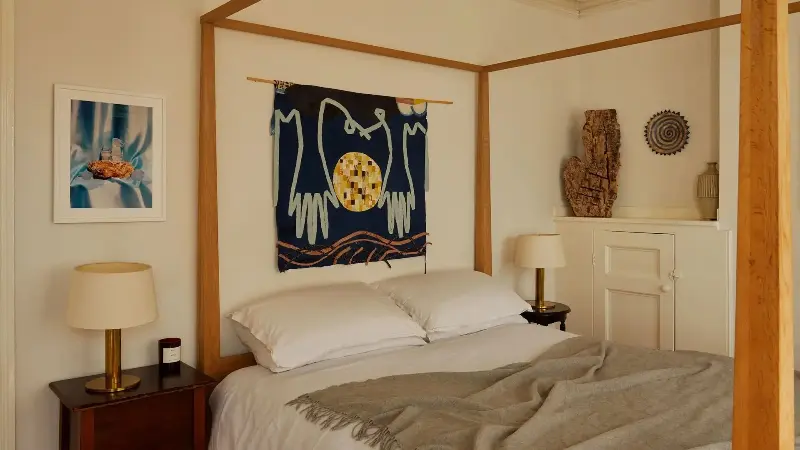

Textile art adds warmth to modern homes
- Designers turn to handmade wall textiles as interiors grow, with artists reworking traditions from Asafo flags to Anni Albers-inspired modernism.
- Uneven stitching, recycled fabrics and plant dyes give works by artists Oscar Crabb and Andrew Pierce Scott a tactile, one-of-a-kind character.
- Designers recommend giving hangings room to breathe, balancing them with smaller art or contrasting wood and metal; panels can dress doors or windows. Read more
Is it just me, or is London all aflutter with tapestry talk? This September, the Bayeux Tapestry crossed the Channel from its namesake town in Normandy, France, to land in a record-breaking exhibition at the British Museum (through July 11, 2027), where hordes of visitors are proving that a good wall hanging never really goes out of style.
Nearly a thousand years have passed since the piece — a 70-meter-long, 50-centimeter-tall figurative artwork chronicling the lead-up to the Norman conquest of England and the Battle of Hastings — was stitched, likely in or around Canterbury. It then left the UK forever, returning to England for the first time earlier this year. But the narrative power of its threads and the myths surrounding it lived on for centuries, weaving its way into modern textiles and home furnishings alike. Spinning yarns of biblical, chivalric drama and moral allegory, tapestries have long been in the business of storytelling. And though they once draped walls to insulate cold, draughty buildings, thanks to the wonder that is central heating, they are now taking up the mantle of decorative art in earnest, across formats and genres.
"For quite some time now, we have been witnessing a revival in craft-led interior design. Textile wall hangings feel like a natural evolution of this," FELT's co-founder Tintin Macdonald tells me. Since launching four years ago, the London-based art consultancy and collectible design shop dreamed up by Francesca Wilson and Macdonald has positioned itself as a site of discovery, led by the notion that walls, and indeed entire spaces, can be immeasurably improved by handmade textiles and objects.
"Many of the contemporary artists we work with at FELT are investigating the historical roots of particular styles and remaking them to create something that feels fresh and relevant for contemporary interiors," Wilson explains. This wider purview, with creatives and makers drawing on the rich symbolism of Ghana's Fante people's Asafo flags as readily as the structural rigor of German artist Anni Albers's 20th-century modernism, anticipates a development of the verdure print tapestry trend Livingetc reported on last spring into something much more malleable and eclectic.
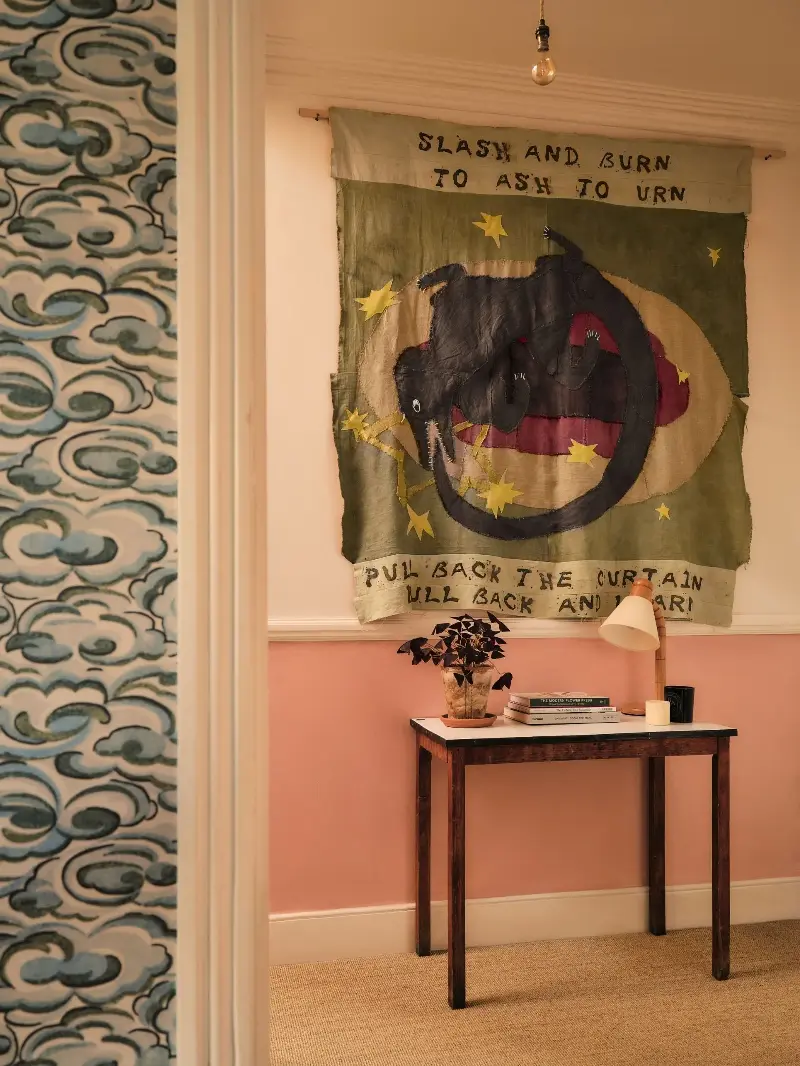
The artists and makers rising in popularity today are those whose work proudly bears its mark-making, reflecting the appeal of related phenomena like the ongoing DIY renaissance. Compared to their mass-produced counterparts, their pieces have a distinctly lived-in quality; uneven stitches, fraying edges and, often, a cloudy, irregular patina that calls to mind processional folk banners.
American artist Andrew Pierce Scott, who counts fashion photographer of the moment, Szilveszter Makó, among his latest collaborators, layers fabric offcuts into textile tablescapes depicting meals shared with family and friends. Oscar Crabb, an artist FELT works closely with, cuts, dyes, and sews every piece by hand, also using second-hand fabric and plant-based pigments such as indigo, madder, and weld, so no two surfaces are quite alike. These creations, charming in their unabashed humanness, inspire an intimacy that forces us to consider materiality.
"You want to get close and understand how they are made," says dealer and curator Gennaro Leone. "People are drawn to that sense of a human hand, and to pieces that give their home some individuality."
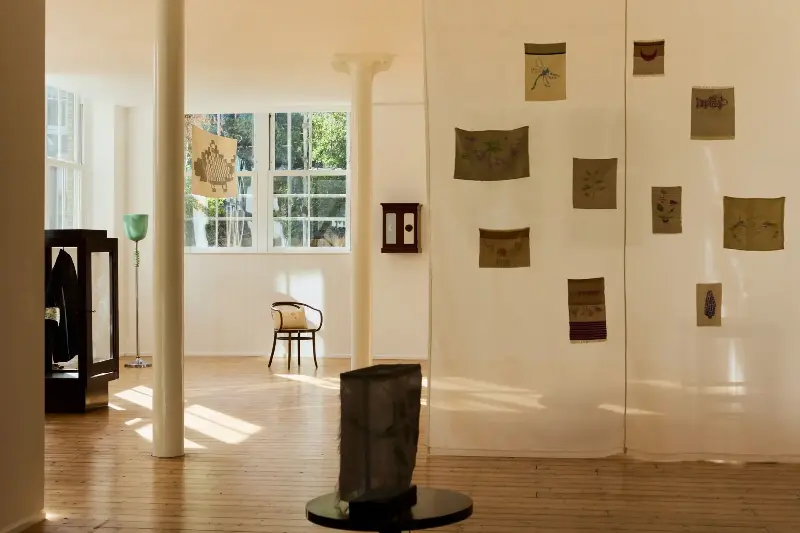
Leone is the founder of East London design gallery Spazio Leone, which recently hosted a solo exhibition of textile works by Central Saint Martins alumnus Yumo Yuan. Yuan's designs are undoubtedly inspired by the idiom of Chinese embroidered silk panels hung in homes and temples across Asia, particularly their auspicious symbolism. Roosters, fish, and chrysanthemum flower motifs — harbingers of a long life and good fortune — are impressed upon their surfaces as if still coming into focus, their edges bleeding into the warp threads. "There is something very delicate about the way the images appear through the weave in Yuan's work," Leone says. "There is a lot of care in the work, but also a playfulness."
Unless you're a practiced maximalist or blessed with an interior grand enough to rival the hallowed halls of yore, styling a larger wall-based piece in a modern setting can require a bit of finesse.
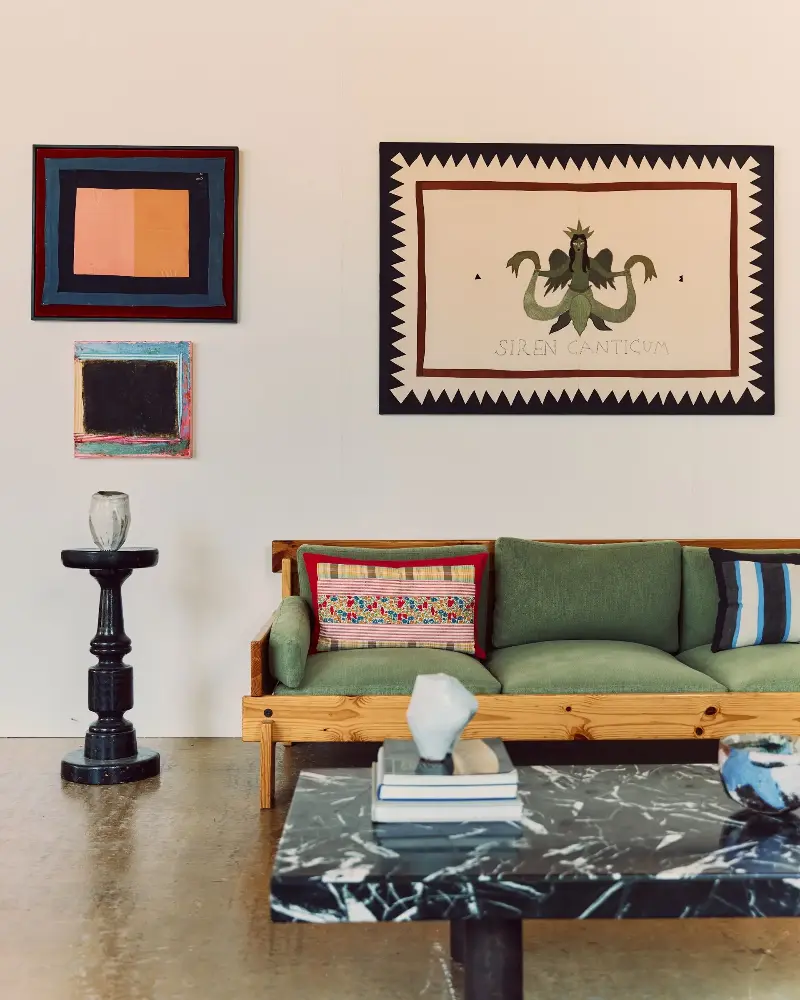
"Clients often want to cover large expanses of space such as the space above their bed, sofa or fireplace, with something that is grounding, welcoming, and enriching," Macdonald says. "At FELT, we like to replace the salon-style hang with a large-scale textile. Then on adjacent walls we might incorporate a mix of mediums like smaller works on paper, or beautifully framed photography."
Kettle's Yard, an art gallery in Cambridge, has styled Ben Nicholson's letters and numbers (1933) linocut scroll alongside smaller paintings in wooden float frames: a curated composition that creates the attractive informal balance that Macdonald describes. In a showroom hosted at The Peanut Vendor last summer, FELT struck a similar note, pairing a large textile featuring a mythical siren figure by artistic partnership Amata Benedict with smaller, expressive geometric mixed-media works by Vicky Pylorides.
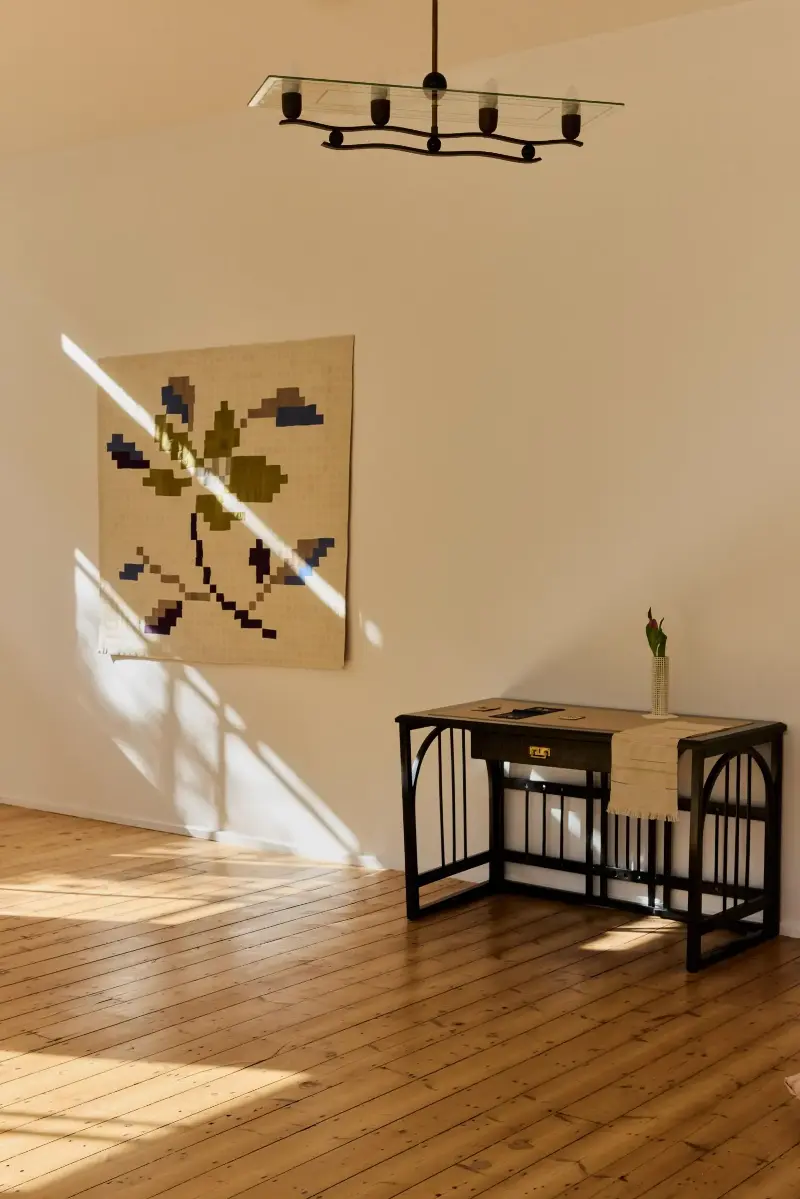
"Textiles bring warmth and softness, but they can also have a very strong presence," says Leone. "I like to give them enough space to be appreciated, while still making them feel part of a room."
At Hoxton café Cremer, one of this year's hottest new London design destinations, Leone and designer Oscar Piccolo hung a diptych made by Yuan in a window, which, from the inside, softens diners' relationship with the station entrance thoroughfare beyond. In Spazio Leone's recent exhibition of the artist's work, he did something similar, tucking another one over a set of buttery cream doors to the left of a black lacquered Dutch cabinet. "I wouldn't necessarily match everything around the colors of the works," Leone adds. "Sometimes an unexpected combination is much more interesting. A textile alongside wood or metal can create a lovely balance."
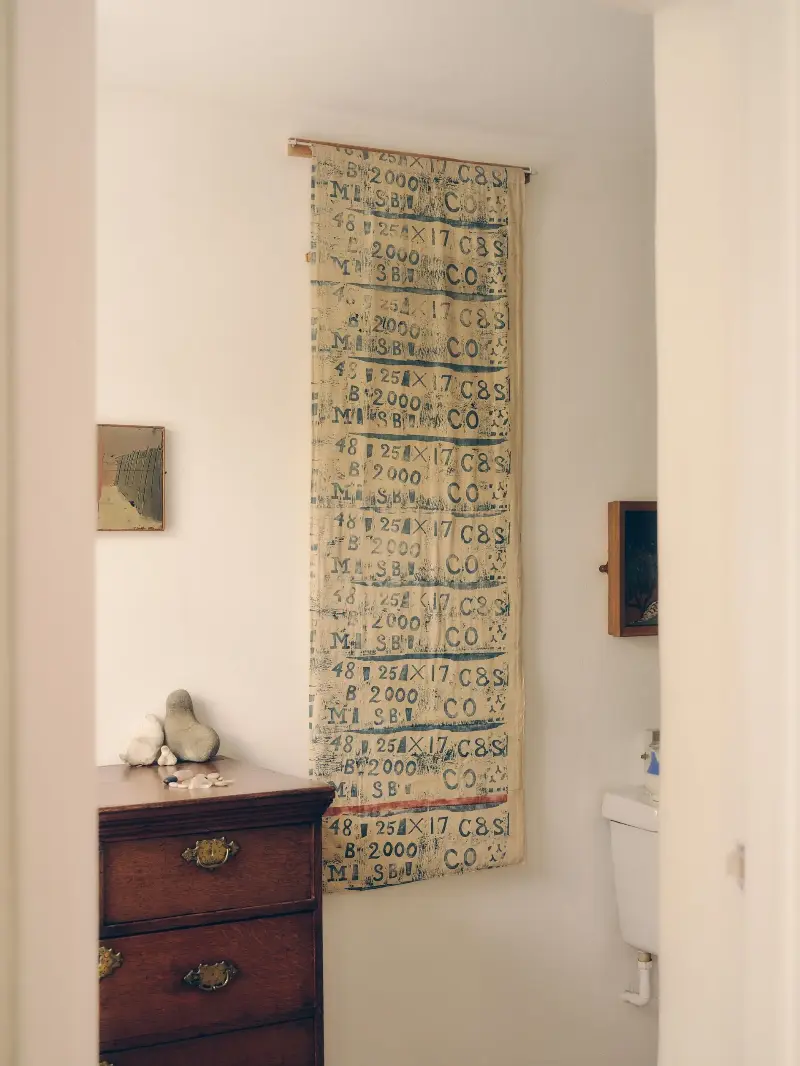
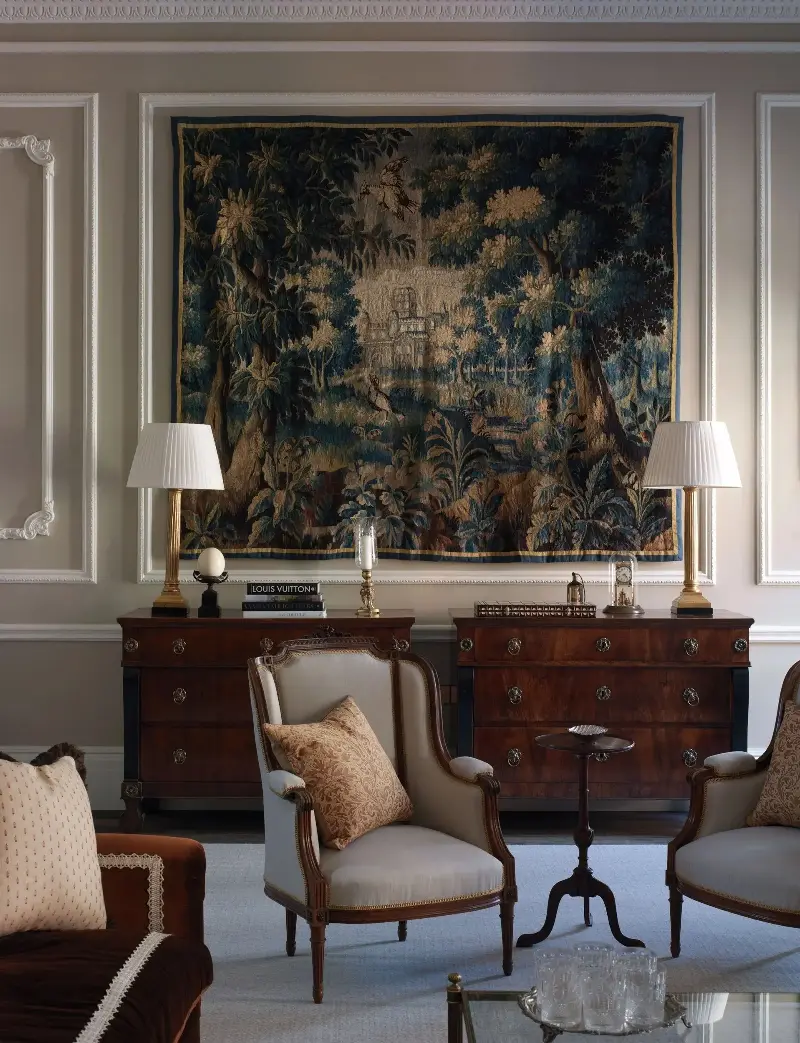
Despite the increasingly folk-inflected and pared-back direction the textile trend has taken, there are plenty of professionals making a case for the heft and drama of lush foliage and woodland-dominated Franco-Flemish verdure or Javanese batik, a wax-resistant textile art from the Indonesian island of Java.
In the sitting room of a Chelsea townhouse, for example, interior designers Sims Hilditch pair a pastoral piece with busily patterned but complementary soft furnishings, demonstrating how materiality can do much of the heavy lifting.
A stone's throw away in Knightsbridge, a similar feature piece is framed in Louis XV/XVI-style boiserie by Albion Nord, the neat lines offset by the curved frames of two bergère chairs. And, some thousand miles east in Colombo, Sri Lanka, in the former home of Tropical Modernism pioneer Geoffrey Bawa, now turned into a holiday stay-cum-museum, the contrast of softly faded, earth-toned textiles with white epoxy floors is anchored by antique teak and mahogany seating.
For those spurred by the thrill of the thrift, sourcing similar works with their own unique character and history is almost too easy. On Vinterior, Etsy, and eBay, kilim rugs, kantha quilts, and antique lace counterpanes are reasonably priced and would work well on a double-height wall or even in place of a headboard.
If scale is an issue, you could instead opt for statement 'off the wall' hangings in less conspicuous placement: under-counter curtains, lampshades, and doorframes. Libu Home's hand-dyed Japanese-style noren panels, room dividers, and door curtains are a beautiful example of how lighter works can add depth and texture to a room. Made from linen and hand-woven ramie — a fiber derived from a non-stinging nettle plant, native to East and Southeast Asia — they provide soft, fluid partitions and stylish concealments. For a more neutral option, fledgling Australian designer Almost Objects's linen and lace applique panels are ideal, leaning into the essentially beautiful Japandi style we love.
As the weather gets colder, why not indulge in a few more long reads of ours? From Raissa Pardini's first-person account of how she made her South East London home work for her newborn and our interiors-led analysis of A24's hottest new release, You Can See Everything, we have got something for everyone, whether you're after our favorite, newest hotel openings for November 2026 or our go-to designers' most treasured gifts.
When in doubt, join our newsletter to receive all of our best stories weekly and in the same place.