


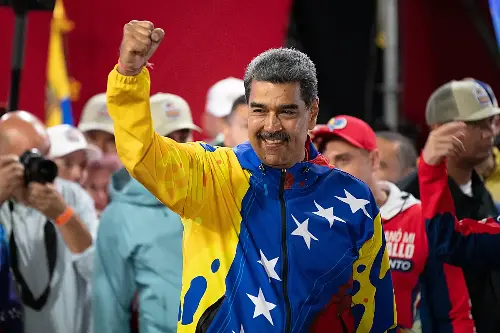
Venezuela once again finds itself caught in a web of controversy following the declaration of Nicolás Maduro as the winner in a hotly contested election. The world's eyes are on this South American nation, which has been grappling with a profound economic crisis, to understand the ramifications of this latest development in its troubled political saga.
Critics, including numerous opposition leaders and international observers, have raised their voices against what they deem as a highly disputed electoral process. Questions about the legitimacy of the elections were fueled by a low voter turnout, accusations of voter suppression, and reports of irregularities at polling stations. The opposition coalition pointed to the use of state resources to campaign for Maduro, while food baskets were allegedly offered to citizens in return for their votes—allegations that the government has stringently denied.
The United States, the European Union, and many of Venezuela's neighbors refused to recognize the election results, calling for a transparent and democratic process. In contrast, allies of the Maduro government, including Russia and China, promptly congratulated him on his victory. This divisive international response underscores the geopolitical stakes at play, as the nation holds the world's largest proven oil reserves. As such, political influence in Venezuela is not just a matter of ideology but also a significant strategic interest for many nations.
In the countries that rejected the results, talk turned quickly to the implications for the already acute humanitarian crisis. Venezuela has been battling hyperinflation, severe shortages of basic goods, and a collapsing healthcare system, prompting over 5 million Venezuelans to flee the country in recent years. With Maduro's re-election, the chances of a swift change in domestic policy seem slim, intensifying concerns about a further deterioration of the situation.
Maduro's government, however, insists the election was free and fair. They attribute the economic crisis to foreign sanctions rather than policy failures and maintain that the government remains committed to the principles of the Bolivarian Revolution, which was initiated by Maduro's predecessor, Hugo Chávez. Maduro's rhetoric centers on resistance against what he calls imperialist interference, a sentiment that still resonates with a portion of the population, despite the hardships.
The post-election period saw an immediate escalation in tensions. Juan Guaidó, the leader of the opposition, was recognized by several countries as the interim president, legitimizing a parallel power structure within the country. This set the stage for widespread protests and international calls for dialogue, further polarizing an already divided nation. Maduro's government has responded with a mix of repression and calls for negotiation, but trust is scarce on the ground.
Accusations of human rights abuses committed by security forces are rampant. Amnesty International and other human rights organizations have reported detentions, torture, and even extrajudicial executions, contributing to the broader narrative of a regime willing to maintain power at any cost. The government defends its actions as necessary for maintaining order and protecting Venezuela's sovereignty.
Beyond the political and human rights dimensions, the Venezuelan crisis has evolved into a case study of the interplay between international diplomacy, economic sanctions, and national sovereignty. Some analysts argue that instead of pressuring the government, sanctions have exacerbated the plight of ordinary Venezuelans. Others advocate for increased pressure to restore democratic norms in a country once seen as one of Latin America's most prosperous democracies.
The complexity of the situation in Venezuela is such that there is no clear path forward. Maduro's declaration of victory did not close the chapter on Venezuela's tumultuous political journey; rather, it added another layer of uncertainty for a population yearning for stability and normalcy. For expatriated Venezuelans and those still living within the country's borders, the disputed election results do little to offer hope of a better future. The world continues to watch as Venezuela navigates through this challenging chapter, hoping for a peaceful and democratic resolution.